
 Log In


Ok guys here we go. To gas or not to gas. What’s your opinion…
Gas. Don’t have time to wash and wash and wash and wash….
I started using gas after a class with Mark Benfield at Surry last year and it has made a big difference in my birds. After you wash one in gas and see the sediment of fat and oils from the bird, you want mount one without gas.
Thanks guys. I have been using coleman fuel for years. Is this what you use? Sometimes I feel like I get a little film on the feathers.
Coleman fuel is what I use John. I get about 10 birds out of a gallon.
Craig Harper wrote: I started using gas after a class with Mark Benfield at Surry last year and it has made a big difference in my birds. After you wash one in gas and see the sediment of fat and oils from the bird, you want mount one without gas.
That’s water you are seeing settled at the bottom, not fats and oils.
No gas no mineral spirits.I’ve been mounting birds for 31 years and always used a degreaser from Wasco and/or mineral spirits after I washed the birds in Dawn, that is, until I read an article in “TaxidermyToday” explaining why there is no need to. As long as you remove the fat with a wire wheel and wash it thoroughly in Dawn (once maybe twice)it should be fine. On really greasy skins I use a handful of mechanics orange hand cleaner(Gojo) and rub it all over the inside skin first. Not only does it cost more to use gas or spirits,your shop won’t smell and you may save yourself a few brain cells!
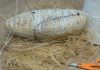
Gas will remove any remaining oils that the wash didn’t remove. It’s mixed into the gas. After gassing, put the fuel lid under your pan so the sediment will settle in a corner. Then you can pour off the cleaner fuel back into the can. Fuels’ main purpose is to dissapate the water from the bird so you can blow dry it quicker. And that stuff that settles in the corner with the water…. is fat. Now if you wash your birds several times, you may not have any in the bottom. But I only have time for 1 wash and 2 rinses. And this is what you get…

Thanks for the info Page and congratulations on the win. My daddy alsways said, “actions speak louder than words” & “proof is in the pudding”. I thought there was some fat in that sediment in the bottom of the fuel.
Any fat that is removed from the skin by the fuel is dissolved by the fuel. That is why the fuel can change color a bit, it has dissolved fat in it. (Re-using this fuel can deposit the fat back onto the feathers, this is probably why John9861 is getting a “film”) The stuff pooled in the corner is dirt and water. Page is a fantastic bird taxidermist, and that is what got him that award. He could have gotten it without the gas, and if I use gas it isn’t going to make me as good as him. Suggesting that gas earned him that award is silly, considering countless awards have been earned from taxidermists not using gas.
I use gas to speed up the drying time. It makes my birds dry a lot faster and I can dry the feathers and not the skin. Because you want your skin to stay wet and stretchy. So you can taxi it arround on the bird body……DC
TAX-E-DERMIST, I don’t think anything I said suggested that Page won that or any other award because he uses gas. I am new to taxidermy and trying to learn the best technique for me and I surely don’t think that I will start winning awards because I use gas. Page can mount a duck blind folded without gas, better than I can mount one with gas or “whatever is the best process” and, my eyes open. So if it came across as me saying Page won competitions because of anything, other than being good, then I’m sorry.
No, I’m with you. Page could mount circles around me too with birds. I was responding to this:
PAGE wrote: And this is what you get…
That makes it sound like gassing will earn me that…and it won’t.

September 26, 2011
 Offline


We started out gassing our birds with coleman fuel. It worked fine, but I felt it was just too dangerous. By properly fleshing and washing, the grease problem is solved. By spinning them out in a washer, tumbling and drying with a bird blaster, we have about the same time in each bird if we were using gas.
All of the birds we have posted on this site were done without using gas. All of the birds in both galleries on our site ( turkeys and waterfowl/upland) were all done without using gas. http://www.gregsfishtaxidermy.com
Taxidermy Talk Administrator
Stehling’s Taxidermy LLC http://www.stehlingstaxidermy.com
Taxidermy Insider / Learn Taxidermy Online http://www.taxidermyinsider.com
920.650.5457 a.n.stehling@gmail.com


You missed it. My statement was meant as a time saver. I wash once for a few minutes. Rinse, and gas for faster drying verses tumbling. I’ve read the tutorial from the other sight and seen how long it takes to wash a bird without gas. I don’t have that much time for washing. In other words, the gas will disolve the fat residue left from washing only once. And your bird will be clean. The picture was just for proof. If I only did birds, I could spend more time washing, and save money by not buying fuel. I’m not saying that gas is better. Just that it works for me. The important thing to remember is that ALL the fat is removed by the wheel. Then whatever washing process you choose will work fine.
I agree if you aren’t tumbling gas would be MUCH quicker.


1 Guest(s)