
 Log In


or is anyone really familiar with the finer points of scoring a whitetail rack? I’ve gotten a pretty good handle on scoring typical antlers, but i got a big non-typical thats got me scratchin my head on how to do it…
I measure for B&C and few other books. Without seeing the rack or having it in my hands, I’m not sure if I can be much help other than to say anything that comes off the main beam in odd places or off of other points including other non-typical points will be considered a non-typical point. If you plan on trying to score more deer or for that matter other game, you can order their manual which is pretty much self explanatory.
i just wanted to check first before posting some pics that someone could offer some good help :)… its actually a big six point with at least three scoreable nontypical points
the tape measure in the pic is at 24″, the inside spread is 22 3/4″ by my measure

Whats got me confused is the gnarly stuff around the bases, how do you score that? Theres a few stickers that ive circled below… could these count as points, or are they not even measured at all…
Gnarly stuff near bases

Stickers
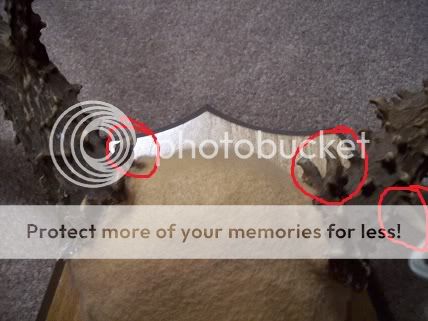
Heres a side veiw of two of the stickers on the left antler

[B]score sheet for whitetail http://www.boone-crockett.org/bgRecords/bc_scoring_typwhitetail.asp?area=bgRecords&type=Typical+Whitetail+Deer
[B]scoresheet for mule deer http://www.boone-crockett.org/bgRecords/bc_scoring_typmuledeer.asp?area=bgRecords&type=Typical+Mule+Deer+%26+Blacktail
you may have to copy and put the url in you browser to get to the web score sheets
the rack looks like a mule deer rack – I already typed this in but it seems to have gotten lost , sorry if this comment shows up twice
I agree with Joe that this may indeed be a mule deer rack, so what may be considered non typical points coming off the G-2’s of a whitetail are actually the G-3’s for a mule deer. The definition of a point is it must be at least 1′ long, and at any point along it’s length at least 1′ down, the lenght must be greater than it’s width. It’s important to note that while measuring, when the tape falls between the 1/8″ marks and lands on a 1/16″ mark or more, it is rounded up except when a point measures less than an actual inch. So if it measures 15/16″ it isn’t rounded up unless it is more than 1” to begin with. The points around the burr get measured from the main beam but not farther underneath towards bone which would give it a longer lenght. Not sure if any of that helped or not.
Yep, that’s a typical mulie with what appears to be no non-typical points.
you’d think its a mule deer at first glance, but its actually a whitetail taken by my great-grandfather on the family plot of land up in the northern part of wisconsin. I’m not sure exactly how old it is, but its between 60 and 80 years old.
Wayne, out of the stickers around the burr, the one closest to the tape measure in the last pic was the only one over an inch, but it came in at 1 3/8″ with a width of 1 5/8″, so then that one would not count as a point, right?
If at onch down or more you can find a spot where the width is less than the length, it is still a point. So if at let’s say 1 1/8 down the width is let’s say 7/8, then widens down at the base to that 1 5/8 it is still a point. Otherwise if the width is bigger all the way down then no it doesn’t qualify as a point.
oh okay, so the measurement i got was at its thickest point, which was exactly one inch down from the tip… about 1/8″ past that it actually narrows down and becomes 1 1/4″ in width, looks like there is another scoreable point… thanks a bunch for the clarification
If I’m understanding you right, you are saying at 1 1/8″ it was 1 2/8″. (everything is measured in 1/8 except skulls are measured in 1/16) If that is the case, the width is larger than the lenght at that point, so no it wouldn’t qualify as a point. At least one inch down anywhere along the point, the lenght at that point needs to be larger than the width. If the lenght is larger than the width anywhere along that point, the whole lenght of that point even though the base may be larger than the overall lenght, is measured for that point. None of those points near the burr look very wide, are you sure you are measuring the width against the lenght on these?
okay, i get it now… wider at that specific “point” as in location on the point itself, i got mixed up with the two meanings of the word point being used… haha
and the other three points along the burr are not over an inch, two are between 6/8″ and 7/8″, and the other is between 7/8″ and 1″, which as you said before couldnt be rounded up, so out of the four burr points, only the one was eligible to be a point


1 Guest(s)