
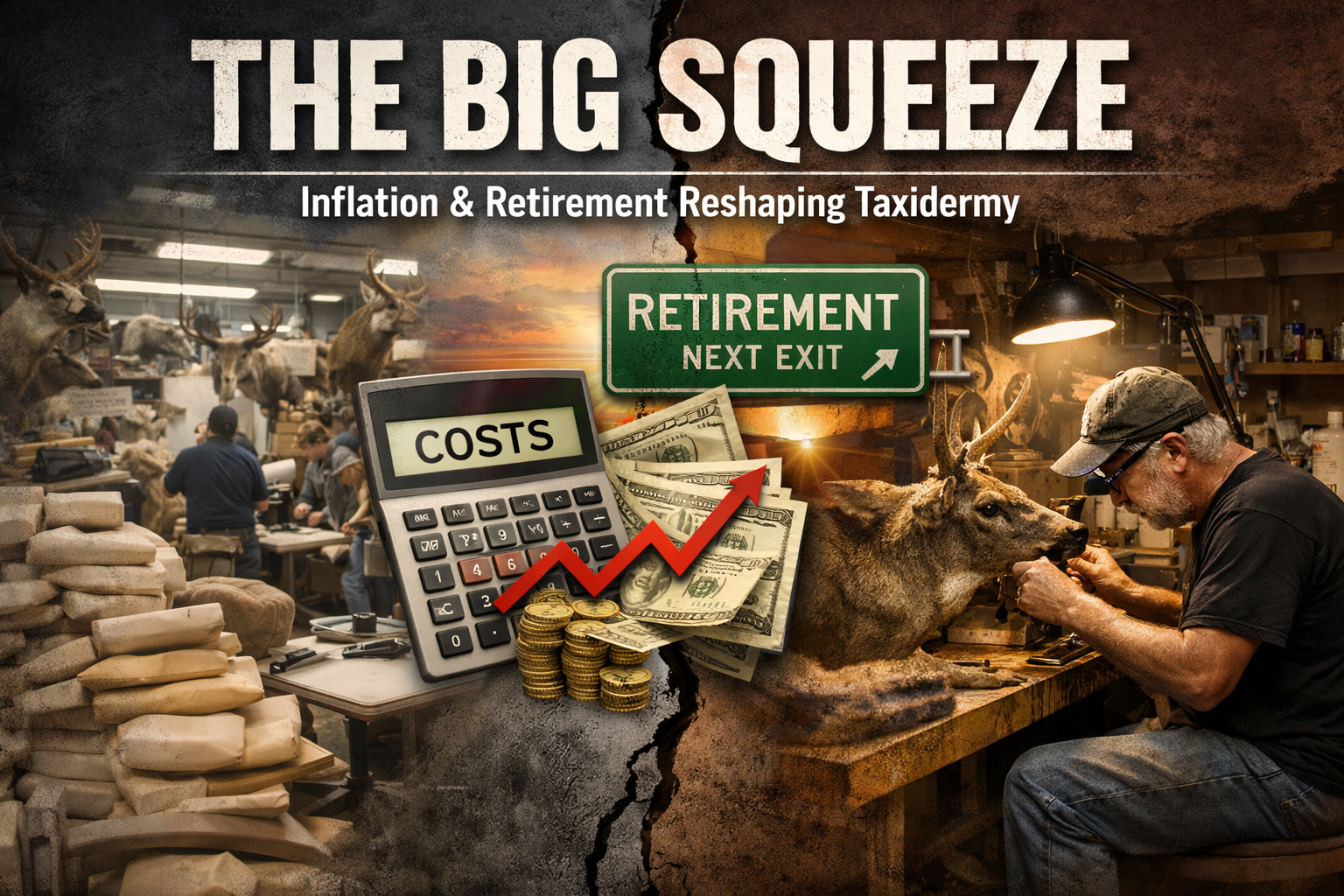
The Big Squeeze: How Inflation and Retirement Are Reshaping Taxidermy
There’s a shift happening in the taxidermy industry—and if you’ve been paying attention, you can feel it.
Shops are closing. Costs are rising. The old guard is stepping away.
And what’s left behind is a new reality that’s getting harder to ignore:
“In today’s taxidermy industry, you’re either big… or you’re small. The middle is disappearing.”
This isn’t speculation. It’s already happening.
The Pressure Isn’t Just in the Shop—It’s Everywhere
When people talk about rising costs in taxidermy, they usually point to materials—forms, tanning, supplies.
But that’s only part of the story.
The real pressure is coming from everything around the business.
-
Rent is higher
-
Utilities cost more
-
Insurance premiums continue to climb
-
Equipment is more expensive to replace or repair
-
Fuel impacts everything from pickups to deliveries
And then there’s the part no one talks about enough:
Your personal cost of living.
Groceries, housing, healthcare—everything has gone up.
“You’re not just trying to run a business anymore—you’re trying to keep up with an economy that’s getting more expensive on every front.”
That changes how you price your work.
It changes what you need to survive.
And it changes what your customers are willing—or able—to pay.
You Can Raise Prices… But Only So Far
Yes, taxidermy prices have increased.
They had to.
But there’s a limit.
At a certain point:
-
Customers hesitate
-
Work slows down
-
Or they start looking elsewhere
That creates a dangerous gap:
Your costs keep rising—but your pricing power doesn’t.
And that’s where many shops start to feel the squeeze.
The Quiet Wave: Taxidermists Are Retiring in Large Numbers
At the same time inflation is tightening margins, the industry is losing a generation.
The baby boomers—who built much of today’s taxidermy landscape—are retiring.
And they’re not being replaced at the same rate.
“We’re watching decades of experience walk out the door—and in many cases, those doors don’t reopen.”
Across the country:
-
Established shops are closing
-
Client lists are being left behind
-
Local markets are suddenly underserved
Not because the work is gone—but because the people doing it are.
The Work Didn’t Disappear—It’s Being Redistributed
Hunters are still hunting.
Memories still matter.
The demand is still there.
So where is all that work going?
The Big Shops Are Expanding
Large operations are stepping in fast.
They have:
-
Staff
-
Systems
-
Capacity
They’re built to handle volume—and now, there’s more volume available than ever.
“When a local shop closes, the big shops don’t just notice—they move.”
They’re absorbing work regionally, sometimes even nationally.
And because of their scale, they can handle rising costs better than most.
The Small Shops Are Stepping Up
At the same time, small and solo taxidermists are filling the gaps in a different way.
-
Low overhead
-
Flexible workload
-
Selective clients
Many are supported by supplemental income, which gives them breathing room.
“Small shops don’t have to feed a machine—they just have to stay sustainable.”
And in today’s economy, that’s a powerful advantage.
The Middle Is Where It Gets Hard
This is where the real pressure shows.
Mid-sized shops are caught between two worlds:
-
Too big to keep costs low
-
Too small to benefit from scale
They carry:
-
Payroll
-
Shop overhead
-
Equipment costs
But they don’t have the volume to spread those expenses out like large operations.
And they don’t have the flexibility of a one-man shop.
“You’re carrying big-shop expenses without big-shop advantages—and that’s a tough place to survive.”
We’ve Seen This Before
This isn’t unique to taxidermy.
It’s the same pattern that reshaped entire industries:
Farming
-
Large operations dominate
-
Small niche farms survive
-
Mid-sized farms disappear
Manufacturing
-
High-volume producers vs. small specialty shops
-
The middle gets squeezed out over time
Taxidermy is now following that same path.
So Where Does That Leave You?
If you’re in this industry today, standing still isn’t really an option.
You have to decide where you fit.
Go Big
Build systems.
Increase volume.
Hire and train.
Operate like a high-quality production business.
Use scale to absorb rising costs—and capture the work left behind by closing shops.
Stay Small
Keep overhead low.
Focus on quality.
Be selective.
Stay flexible.
Build a reputation—not a pipeline.
But Be Careful in the Middle
Without a clear strategy, the middle is becoming the hardest place to operate.
Final Word
This isn’t the decline of taxidermy.
It’s a restructuring.
Inflation raised the pressure.
Retirement accelerated the shift.
And what’s left is a more defined industry than ever before.
“The future of taxidermy won’t be decided by who’s the best with a mount—it’ll be decided by who builds a business that can survive the pressure around it.”