
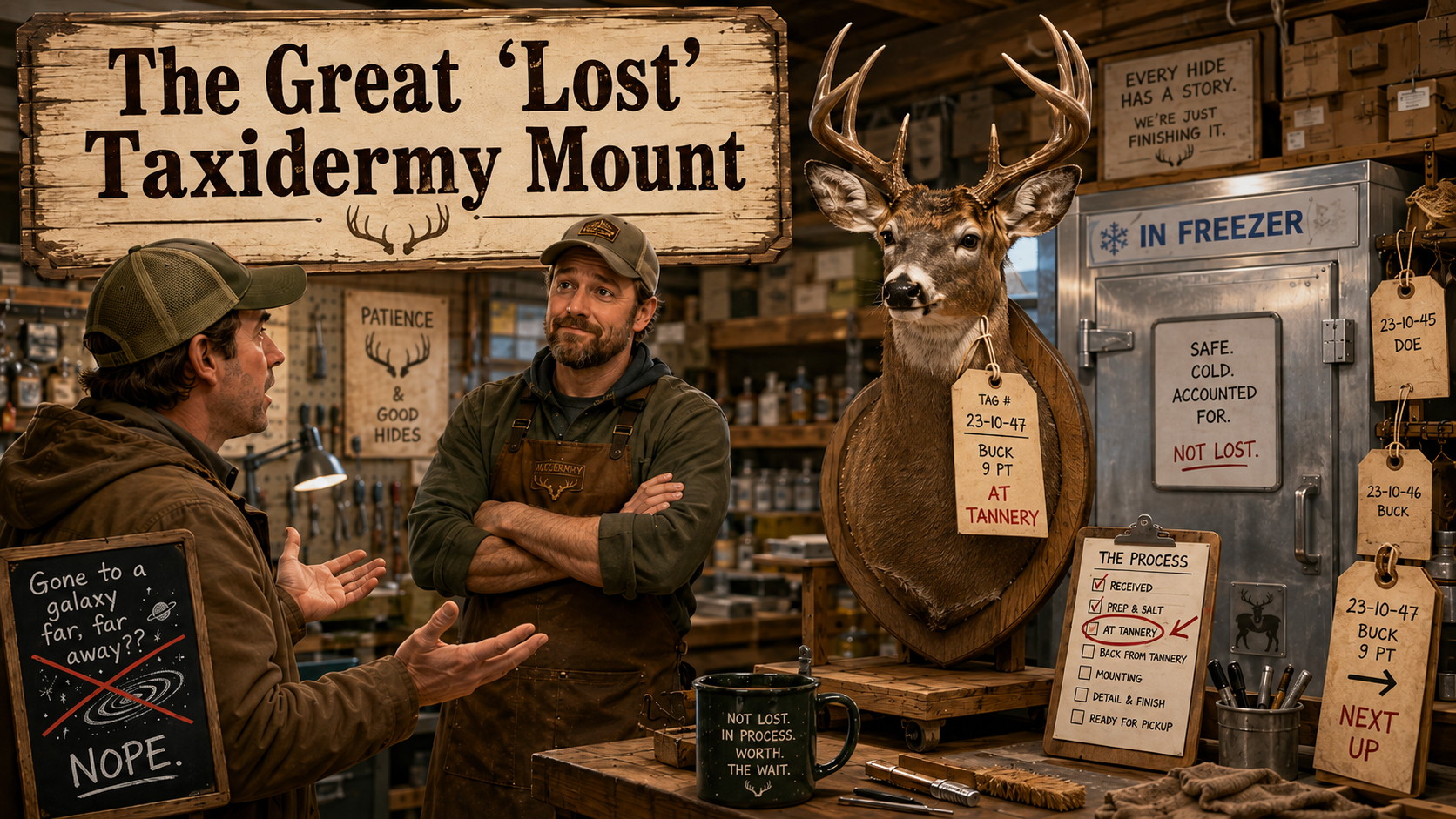
The Great “Lost” Taxidermy Mount
There is a mysterious place somewhere in the taxidermy universe where, apparently, thousands of deer heads, elk capes, bears, fish and other trophies simply disappear.
A black hole.
A galaxy far, far away.
A secret warehouse full of “lost” mounts that taxidermists are desperately hoping nobody ever asks about again.
At least, that is what you would think based on one of the questions taxidermists hear all the time:
“You didn’t lose my mount, did you?”
Or:
“I was just calling to make sure it didn’t get lost.”
Or my personal favorite:
“My buddy said if it isn’t done by now, you probably lost it.”
No.
We did not lose your mount.
It did not fall behind the freezer.
It was not accidentally shipped to Nebraska.
Nobody took it home and hung it over their fireplace.
It is almost certainly exactly where it is supposed to be in the taxidermy process.
Maybe it is at the tannery.
Maybe it is in the freezer waiting for the next stage.
Maybe the hide is back from the tannery and waiting to be mounted.
Maybe the form has been ordered.
Maybe it is mounted and drying.
Maybe it is waiting for finish work.
Maybe there are forty other pieces moving through different stages of production at the same time.
But somewhere along the way, “not finished yet” has somehow become “they must have lost it.”
And I have to admit: after hearing it enough times, it can be incredibly insulting.
Where Does the “Lost Mount” Idea Come From?
All kidding aside, I think there is actually something interesting going on here.
Why does a customer’s mind sometimes jump from:
“My mount isn’t finished yet”
to:
“My taxidermist must have lost it”?
There are probably several reasons.
1. People Don’t Understand the Taxidermy Process
This is probably the biggest one.
Most customers only see two moments in the entire process.
They drop the animal off.
Then, months later, they pick up the finished mount.
Everything in between is invisible.
They don’t see the freezing, fleshing, salting, tanning, form preparation, alterations, mounting, drying, sewing, finish work, painting, habitat work and dozens of other little steps involved in producing a quality mount.
If somebody doesn’t understand how long those stages can take, silence can create uncertainty.
And when people don’t know what is happening, they tend to fill in the blanks themselves.
Unfortunately, sometimes the blank gets filled with:
“They lost it.”
2. Somebody Got in Their Head
This happens constantly.
A customer may have been perfectly comfortable with the timeline until they talked to a buddy, coworker, brother-in-law or hunting partner.
Then they hear:
“My taxidermist already finished mine.”
Or:
“Man, you still don’t have that deer back?”
Or:
“If it’s taking that long, they probably lost it.”
Now the customer starts wondering.
Never mind that the other mount might be a completely different species.
Never mind that it could have been taken to a shop with a completely different workload.
Never mind that one taxidermist may send hides to one tannery while another uses a different process.
Never mind that quality levels, staffing, seasonal volume and production systems vary tremendously between shops.
None of that matters once somebody plants the seed.
And let’s face it: buddies and family members can be some of the biggest troublemakers on Earth when it comes to putting ideas into somebody’s head.
Sometimes it is genuine concern.
Sometimes it is ignorance.
Sometimes it is jealousy.
And sometimes your buddy is just being a pain in the ass because that is what buddies do.
3. Customers Are More Nervous About Their Trophy Than We Realize
This is the part taxidermists probably need to pay the most attention to.
When I have looked at customer pain points surrounding taxidermy, one issue that repeatedly stands out is confidence that the customer will actually receive their own trophy back safely and correctly.
And when you think about it from their perspective, that fear makes some sense.
A trophy animal is not replaceable.
You cannot call Amazon and order another 170-inch whitetail you shot with your dad.
You cannot replace the elk from a once-in-a-lifetime western hunt.
You cannot replace Grandpa’s fish, your kid’s first buck or the bear you spent ten years trying to kill.
To us, the animal may be one piece moving through an organized production system.
To the customer, it may represent one of the most important hunting memories of their life.
That difference in perspective matters.
Their question may sound ridiculous to us.
But underneath the ridiculous question may simply be:
“Is something that means a lot to me still safe?”
That is a much easier question to answer without getting irritated.
Why Taxidermists Get So Annoyed By It
There is another side to this conversation.
Imagine asking a mechanic:
“You didn’t lose my truck, did you?”
Imagine asking a jeweler:
“You didn’t lose my wedding ring, did you?”
Imagine calling a body shop:
“I just wanted to make sure you still have my car.”
After the tenth or twentieth time somebody asks, you would probably start wondering what kind of operation they think you are running.
Taxidermists feel the same way.
Most established shops have tagging systems, customer records, freezer organization, tannery records, work orders and production procedures specifically designed to keep track of customer property.
We know where your mount is.
We know what stage it is in.
And in many shops, we can probably tell you which freezer, rack, tannery shipment or production batch it belongs to.
So when somebody casually suggests we may have simply “lost it,” it can feel like they are questioning the basic competence and integrity of the business.
That gets old.
Very quickly.
But Blowing Up at the Customer Doesn’t Help
This is where taxidermists—including me—have to remind ourselves of something.
Getting angry might feel good for about thirty seconds.
It usually does absolutely nothing to improve the situation.
If a customer says:
“You guys didn’t lose my deer, did you?”
your first instinct might be:
“What the hell kind of business do you think we run?”
Probably don’t say that.
Instead, translate what the customer is really asking.
They are usually asking:
“Can you reassure me that everything is okay?”
That is a much easier conversation.
Something as simple as:
“Yep, we have it. Everything is fine. Your cape is currently at the tannery, and once it comes back it moves into the next stage.”
Problem solved.
Customer feels better.
You keep your blood pressure somewhere within the normal human range.
Everybody wins.
A Few Ways Taxidermists Can Keep Their Cool
First, don’t take every stupid question personally.
Customers do not live inside our businesses. What seems obvious to us may not be obvious to them.
Second, answer the concern behind the question instead of the wording of the question.
“You didn’t lose it, did you?”
really means:
“Can you confirm everything is okay?”
Third, give them one concrete piece of information.
Instead of saying:
“No, we didn’t lose it.”
say:
“We have it. Your cape is at the tannery right now.”
That one sentence eliminates most of the uncertainty.
Fourth, educate customers before the questions start.
Explain the major stages when they drop the animal off.
Freezer.
Tannery.
Prep.
Mounting.
Drying.
Finish work.
Pickup.
If customers understand that their trophy may spend months moving through different stages, they are less likely to assume nothing is happening.
And finally, sometimes you just have to laugh.
Because if you stay in taxidermy long enough, somebody is eventually going to call and ask whether you lost the 200-pound bear they dropped off.
And sometimes the only reasonable response—at least the one you say inside your own head—is:
“Yep. We’ve been looking everywhere for him.”
Communication Is Probably the Real Issue
As much fun as it is to make fun of the Great Lost Taxidermy Mount, there is a business lesson buried underneath it.
Customers want confidence.
They want to know their trophy is safe.
They want to know their taxidermist remembers them.
And they want some reassurance that their mount is moving through the process.
That does not mean a shop needs to provide weekly progress reports or answer twenty phone calls asking whether a deer moved six inches farther down the rack.
But good communication can eliminate a lot of unnecessary anxiety.
An automated text when the cape comes back from the tannery.
A production-status page.
A message when the mount enters production.
Even a clear explanation at drop-off can make a tremendous difference.
Because most of the time, the customer is not actually accusing you of losing their mount.
They are worried about something they cannot replace.
Remembering that makes the question a little easier to tolerate.
Even when their buddy Dave is standing behind them saying:
“I told you they probably lost it.”
No, Dave.
We didn’t lose it.
It’s at the tannery.