
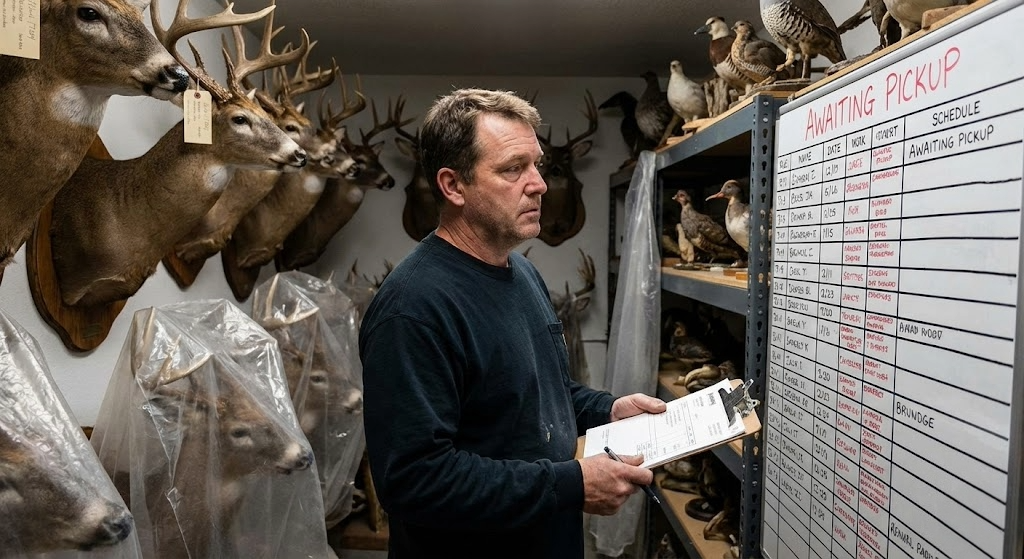
When Customers Don’t Pick Up: Protecting Your Taxidermy Shop From Completed-Mount Backlog
A Follow-Up to Building a Successful Taxidermy Workflow
Every taxidermist eventually runs into the same frustrating problem:
The mount is finished.
The customer is happy.
And then… they disappear.
No pickup. No payment. No return calls.
For a taxidermy shop, this is more than an inconvenience — it becomes a serious production and financial issue. Finished mounts take up space, prevent workflow from moving forward, and delay income that you’re counting on.
If this becomes common, your entire shop can get trapped in a cycle where you’re forced to mount and finish twice as much work just to collect the same amount of money.
This article covers how to try to prevent pickup problems, how to create urgency, and how to build a system that protects your time, space, and cash flow.
The Hidden Cost of “No Pickups”
When a customer doesn’t pick up their finished mount, the shop loses in multiple ways:
-
You lose the final payment
-
You lose storage space
-
You lose workflow efficiency
-
You lose time responding to repeated messages
-
You lose the ability to complete and deliver other mounts
- Your stress levels increase
Most importantly, you lose momentum.
A shop that is full of completed mounts starts to feel stuck. You can’t move forward because your shop is physically clogged with finished work, and your cash flow begins to depend on chasing customers instead of producing.
No pickups create a dangerous trap:
your shop becomes a storage unit instead of a production shop.
The “Double Work” Problem
Many taxidermists unknowingly fall into this cycle:
They finish ten mounts.
Only five customers pay and pick up.
The other five sit.
So the taxidermist has to finish another ten mounts just to bring in enough cash to cover bills.
The shop becomes a hamster wheel — constant production, but inconsistent payment.
This is where taxidermists start burning out, not because they can’t do the work, but because the workflow stops producing predictable income.
The Most Effective Strategy: Tell Customers Before You Mount
One of the best ways to prevent pickup delays is to create customer involvement before the mount is finished.
Instead of surprising them with a finished product, notify them when their mount enters key stages:
-
“Your deer is on the schedule for mounting next week.”
-
“We’ll be finishing and painting your bird this week.”
-
“Your mount is in final stages and will be completed soon.”
This accomplishes two things:
1. It Creates Anticipation
Customers begin mentally preparing.
2. It Creates Financial Readiness
They realize they’ll need to pay soon and begin budgeting.
Most pickup issues aren’t because customers are unhappy — it’s because they weren’t prepared for the timing of the final bill.
A simple heads-up reduces delays dramatically.
Pickup Problems Often Come From One Thing: Surprise
Customers may drop off an animal and hear “8–12 months.”
But when 10 months passes quietly, they stop thinking about it.
Then suddenly they get a call:
“Your mount is done. You owe $850.”
That feels like an unexpected expense, even if they agreed to it.
Good workflow includes customer communication that keeps the mount in their mind.
Should You Send Finished Photos? Pros and Cons
Sending finished pictures is one of the most debated topics in the taxidermy business.
It can be a powerful tool — but it can also backfire.
The Benefits of Sending Finished Photos
Sending completion photos can:
-
Build excitement
-
Confirm customer satisfaction
-
Reduce disputes
-
Create a record of quality at delivery
-
Help you catch last-minute adjustments early
It also reassures the customer that the job is complete and professional.
In many cases, it makes pickup faster because they’re impressed and eager.
The Danger of Sending Finished Photos
However, there is a real downside:
Once a customer sees the finished product, some of the urgency disappears.
The “wow moment” is partially spent. The emotional excitement they would have felt walking into your shop is now reduced.
For certain customers, the photo becomes enough. They think:
“Awesome. Looks great. I’ll grab it sometime.”
And “sometime” turns into months.
Finished photos can unintentionally reduce urgency if you don’t pair them with clear pickup expectations.
The Right Way to Send Finished Photos
If you choose to send finished photos, it should be paired with a strong pickup message.
Instead of:
“Your mount is finished!”
Say:
“Your mount is finished and ready for pickup. Total balance due is $____. Please schedule pickup within the next 7 days.”
This keeps the photo from becoming entertainment and reinforces that completion means it’s time to close the job.
Reminder Texts, Calls, and the Importance of a Paper Trail
No matter how good your workflow is, you will still have customers who delay.
The key is to stay professional, consistent, and documented.
A good system includes:
-
A completion message
-
A reminder after 7 days
-
A reminder after 14 days
-
A billing notice after 30 days
All communication should be saved.
Texts and emails create a paper trail that protects your shop if disputes arise.
If the situation ever becomes legal or requires a collections process, documentation is your strongest defense.
Storage Policies: The Most Important Tool You Have
A storage policy is not “being mean.”
It is a business necessity.
Every finished mount sitting in your shop costs you:
-
Space
-
insurance risk
-
damage risk
-
time moving it around
-
lost production capacity
If your shop is full of completed mounts, you cannot operate efficiently.
Many shops adopt a policy such as:
-
30 days free storage after completion
-
storage fee begins after 30 days
-
mounts may be sold or disposed of after a defined period (where legal)
Even if you never enforce the final step, simply having the policy prevents most issues.
The goal is not punishment — it’s urgency.
Creating Urgency Without Damaging Customer Relationships
The best pickup systems feel professional, not aggressive.
A good pickup message should sound like:
-
“We want to make sure your mount stays safe.”
-
“We have limited space for completed mounts.”
-
“Our shop schedule depends on completed work being picked up.”
When customers understand that your shop is a production business — not a warehouse — they are more likely to respect your time.
Don’t Be Afraid to Require Final Payment Before Pickup Scheduling
One of the strongest strategies many shops use is:
“Final payment required before scheduling pickup.”
This eliminates wasted time coordinating pickups that never happen.
It also removes the uncomfortable moment where the customer sees the mount, becomes emotional, and tries to negotiate pricing.
The mount is complete. The balance is due. Business stays clean.
The Hard Truth: Pickup Delays Hurt the Taxidermist More Than the Customer
The customer can delay pickup with no real consequences.
But the taxidermist pays the price every day that mount sits there.
This is why taxidermists must treat pickup policies as part of workflow, not as an afterthought.
A strong workflow doesn’t end at finishing.
It ends when the mount leaves the building.
Final Thoughts: A Finished Mount Isn’t Finished Until It’s Gone
The difference between a thriving shop and a stressed shop is often not production skill.
It’s follow-through.
When customers don’t pick up, it forces the taxidermist into a dangerous production cycle: working harder, storing more, and collecting less.
But with the right communication system, clear policies, and consistent reminders, most pickup issues can be prevented.
Your shop should not be a storage unit.
Your workflow should produce:
-
completed mounts
-
completed payments
-
and completed deliveries
Because in the end, the mount isn’t truly finished until it’s out the door.