
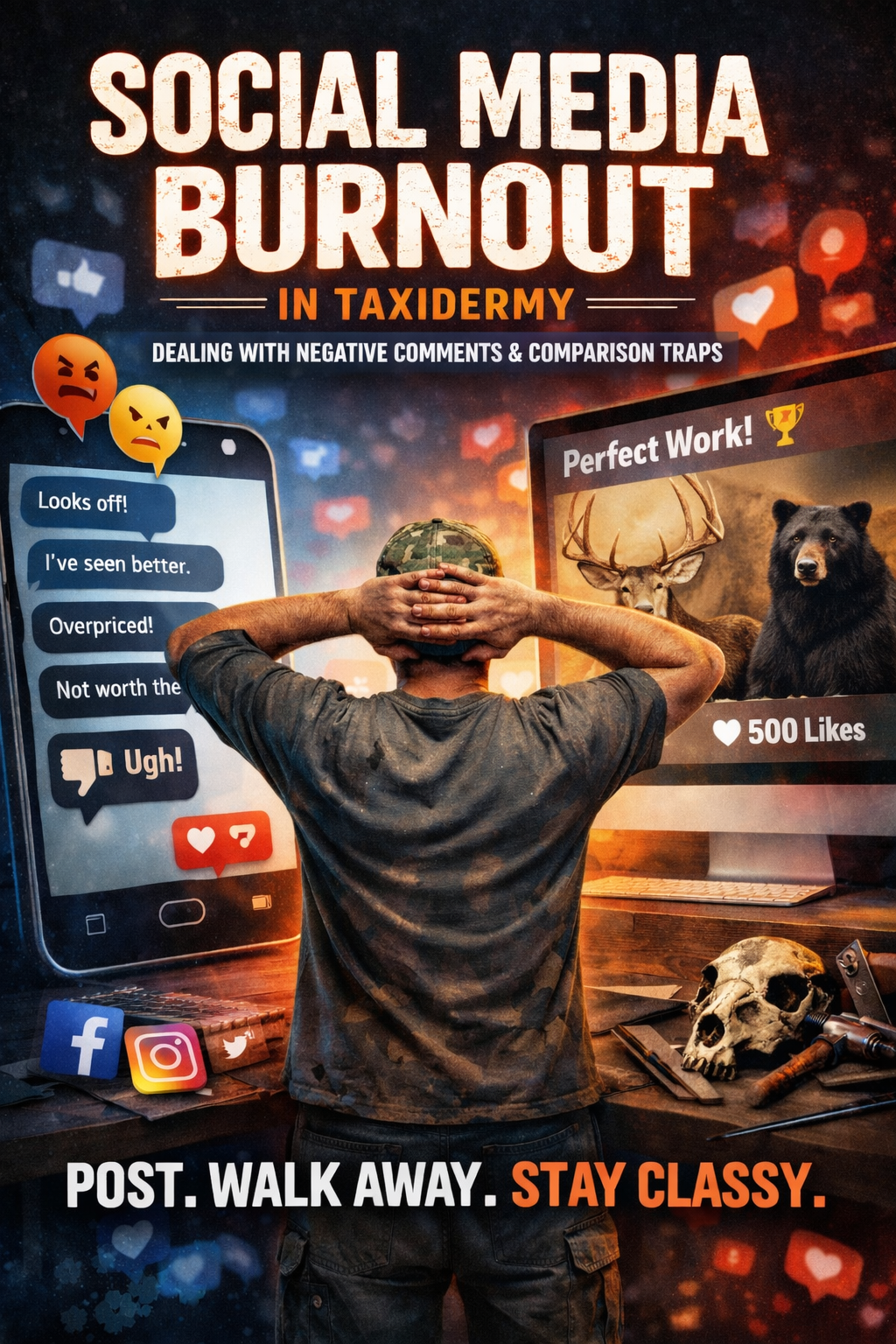
Social Media Burnout in Taxidermy: Staying Sane in a World of Highlight Reels
If you’re a taxidermist in today’s world, social media probably feels like a necessary evil. On one hand, it’s one of the best advertising tools we’ve ever had. On the other hand, it can drain your energy, mess with your confidence, and turn what used to be a passion into a performance.
Burnout from social media is real—and for many taxidermists, it’s becoming one of the most overlooked stress factors in running a shop.
This article is for the taxidermists who feel exhausted by the constant pressure to post, the negative comments, the comparison trap, and the mental noise that comes with putting your work out there for the world to judge.
Let’s talk about how to handle it.
The Hidden Weight of Posting Your Work
Most people scrolling Facebook or Instagram don’t realize what goes into taxidermy. They don’t see the hours of fleshing, caping, turning ears, setting eyes, repairing damage, shaving forms, rebuilding noses, painting, drying time, and reworking details.
They see one picture.
And because they don’t understand the process, they feel comfortable judging it like it’s a fast-food meal.
That disconnect is where burnout starts.
Because for a taxidermist, every mount is a reflection of your skill, your pride, and your reputation. Posting your work can feel like putting your name on a billboard and asking strangers to critique your life.
And that wears you down.
Drive-By Comments: The “Cheap Shot” Culture
If you’ve been on social media long enough, you’ve seen them:
-
“Looks good but the eyes are off.”
-
“I’ve seen better.”
-
“My buddy can do that cheaper.”
-
“That cape looks short.”
-
“Why is the nose like that?”
-
“Not worth the money.”
Most of the time these comments come from one of three types of people:
-
Someone who doesn’t understand taxidermy
-
Someone trying to impress others by sounding knowledgeable
-
Someone intentionally stirring drama
These are “drive-by negotiators.” They don’t want a mount. They want attention. They want to feel powerful. And they know that criticizing someone’s work online is a quick way to get a reaction.
The problem is: if you’re tired, overworked, and already stressed… those comments hit like a punch.
Should You Respond, Delete, or Block?
There’s no single right answer—but there is a smart strategy.
1. When to Respond
Respond when:
-
the comment is a genuine question
-
the person seems confused but not hostile
-
it’s a chance to educate professionally
A good response is short, calm, and confident.
Example:
“Thanks for the feedback. Photos can sometimes distort angles, but the mount is built to correct anatomical reference. Appreciate you checking it out.”
That kind of response shows professionalism without inviting debate.
2. When to Delete
Delete when:
-
the comment is rude, insulting, or trolling
-
it’s clearly meant to provoke
-
it damages your brand image in the comments section
Your business page is not a public debate arena. It’s your showroom.
If someone walked into your shop and started insulting your work in front of customers, you wouldn’t “leave it up for discussion.” You’d remove them.
Deleting isn’t weakness—it’s professionalism.
3. When to Block
Block when:
-
someone repeatedly comments negativity
-
they attack you personally
-
they bring drama or politics
-
they are clearly not a customer and never will be
Blocking is not “being sensitive.” Blocking is protecting your peace.
And protecting your peace is protecting your business.
The Emotional Rollercoaster of Seeing Other Shops’ Work
One of the most toxic parts of social media isn’t even the negative comments.
It’s the comparison.
Taxidermists are artists. And artists are naturally competitive and detail-oriented. So when you scroll and see another shop posting flawless shoulder mounts, insane lifelike eyes, perfect habitat scenes, or constant customer praise…
It’s easy to feel:
-
discouraged
-
behind
-
frustrated
-
jealous (even if you hate admitting it)
-
like your work isn’t good enough
-
like you’re losing customers
Even if you’re doing great.
And the truth is: social media can distort reality.
Remember: Social Media is a Highlight Reel
What you’re seeing online is not always the full story.
Some shops only post their best mounts.
Some shops only post after heavy editing and filters.
Some shops stage photos with lighting and angles that hide flaws.
Some shops outsource work.
Some shops post old work and pretend it’s current.
Some shops are drowning behind the scenes even if their page looks “perfect.”
A photo doesn’t show:
-
turnaround time
-
customer service issues
-
quality consistency
-
business health
-
how many remakes happened
-
how many customers are upset
It’s entirely possible for a shop to look like a world-class operation online while their real-life shop is chaos.
So if you’re comparing your behind-the-scenes reality to someone else’s best moments, you’re going to lose every time.
That’s not a fair fight.
The Confidence Trap: When Social Media Makes You Doubt Yourself
One of the worst parts of burnout is that it slowly makes you question your own ability.
You start thinking:
-
“Maybe I’m not that good.”
-
“Maybe I should change everything.”
-
“Maybe I’m falling behind.”
-
“Maybe people secretly hate my work.”
And then you overthink everything:
-
ear placement
-
nose detail
-
eye set
-
paint tone
-
cape length
-
symmetry
Now, improving your craft is good. But obsessing over social media perception is not improvement—it’s anxiety disguised as motivation.
How to Use Social Media Correctly (Without Letting It Use You)
The healthiest approach is to treat social media like a tool, not a lifestyle.
A hammer is useful. But if you carry it around all day and stare at it every 15 minutes, you’re going to lose your mind.
Social media should serve your shop—not control your mood.
A Practical Strategy
A great rule is:
Post with purpose, then walk away.
Post your work.
Respond to real customer questions.
Then get back to the shop.
You don’t need to refresh the likes.
You don’t need to watch who viewed your story.
You don’t need to compare your mount to someone else’s mount from three states away.
The work will speak for itself.
Set Boundaries: The Best Taxidermists Aren’t Always the Loudest
Some of the best taxidermists in the country barely post at all. Their work speaks through word of mouth and consistent quality.
Don’t fall into the trap of thinking you need to become a “content creator” to be successful.
You are a taxidermist.
Your job is to produce excellent work, take care of customers, and build a reputation that lasts longer than an algorithm.
Keep Your Business Page Classy and Business-Only
This is a huge one.
A business page is not the place for:
-
personal arguments
-
political opinions
-
drama
-
calling out other shops
-
emotional rants
-
responding sarcastically to critics
Even if you’re right, it makes your shop look unstable.
Customers don’t want to hire someone who seems reactive online. They want someone who looks calm, professional, and trustworthy with their trophy.
If someone comments something negative and you respond with anger, you might “win” the argument…
…but lose the customer watching quietly from the sidelines.
The best response is usually:
no response at all.
Silence is classy.
Silence is powerful.
Silence protects your brand.
Your Reputation is Built in the Shop, Not the Comments Section
At the end of the day, customers remember:
-
how they were treated
-
how their trophy turned out
-
if you communicated clearly
-
if you delivered what you promised
Not whether you clapped back at a guy named “BigBuckSlayer420” on Facebook.
A shop is built through consistency, not internet debates.
How to Protect Your Mental Health as a Taxidermist
Here are a few habits that help:
1. Stop Scrolling Before Work
Don’t start your morning comparing your work to others. You’ll walk into the shop already drained.
2. Schedule Posting Times
Pick one or two times per week to post.
Don’t make it an everyday obligation unless you truly enjoy it.
3. Take Breaks
It is completely acceptable to step away for a month.
Customers won’t forget you.
The right customers will still find you.
4. Remember Who You’re Posting For
You’re not posting for trolls.
You’re posting for customers.
5. Focus on Your Craft
Nothing rebuilds confidence like improving your work and staying busy.
Your best comeback is always quality.
Final Thoughts: Don’t Let Social Media Steal Your Passion
Taxidermy is a rare skill. It’s demanding, technical, artistic, and deeply meaningful to the people who bring you animals.
Social media can be an amazing tool for showcasing your craft—but it can also burn you out if you let it.
The truth is, you don’t owe anyone access to your peace.
You don’t owe trolls a response.
You don’t owe strangers an explanation.
You don’t owe the algorithm your sanity.
Stay classy. Stay professional. Keep improving.
And when the noise gets loud?
Post your work.
Then walk away.
Because the mount is what matters.