
The Taxidermist’s Safety Net
Building a Shop-Ready First Aid Kit for Real-World Hazards
In a profession where we juggle scalpel-sharp knives, heavy-duty degreasers, jagged armature wire, and high-heat tools, an accident isn’t just possible — it’s inevitable.
When you’re deep in the rhythm of a mounting session, a split-second slip or stray wire poke can derail your entire day. In a matter of seconds, precision work turns into bleeding knuckles, chemical burns, or worse.
That’s why a well-stocked, easily accessible first aid kit is just as essential as your favorite fleshing machine or airbrush. In a working taxidermy studio, safety isn’t optional — it’s operational.
Here’s how to build and maintain a kit designed specifically for the real hazards of the trade.
Why a Standard Kit Isn’t Enough
An “office” first aid kit may handle paper cuts and headaches. It won’t cut it in a taxidermy shop.
Our work exposes us to unique risks:
-
Deep Cuts: Razor-sharp scalpels, skinning knives, and fleshing blades.
-
Wire Punctures: Rusty or stiff armature wires capable of driving bacteria deep into tissue.
-
Chemical Exposure: Acids, tanning agents, degreasers, and solvents that require immediate flushing.
-
Thermal & Friction Burns: Hot glue guns, torches, grinders, and high-speed tools.
A shop-ready kit must reflect these realities.
The Essential Shop Checklist
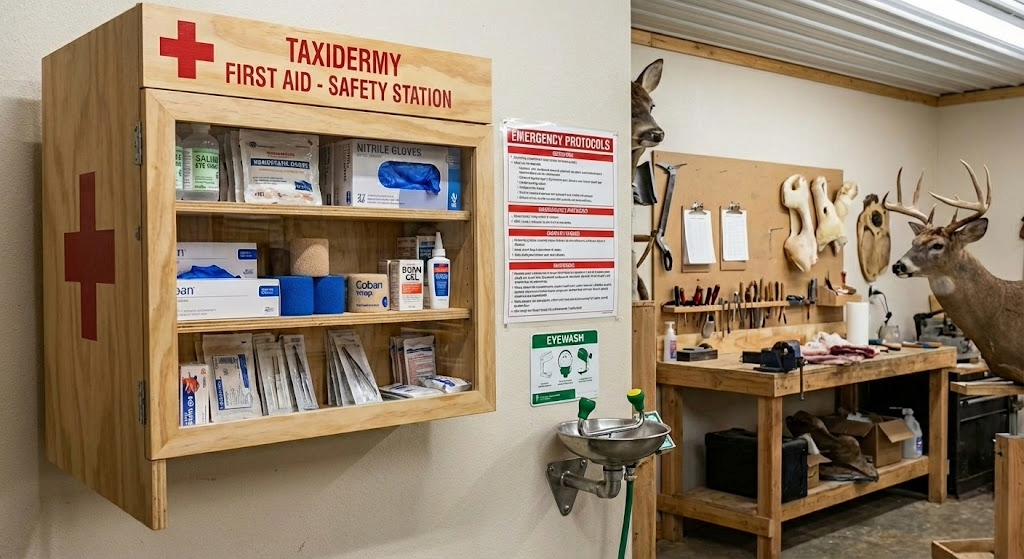
Beyond standard adhesive bandages and gauze pads, your taxidermy kit should include:
Saline Eye Wash
Critical for flushing sawdust, hair, or chemical splashes. Consider installing a dedicated eye wash station if possible.
Hemostatic Gauze (e.g., QuikClot)
Designed to rapidly stop heavy bleeding from a deep knife slip. In a profession filled with blades, this is not optional.
Antiseptic Wipes & Antibiotic Ointment
Essential for cleaning “dirty” cuts contaminated by hide, hair, or shop debris.
Butterfly Bandages or Steri-Strips
Useful for closing deeper lacerations when stitches aren’t immediately available.
Burn Gel (with Lidocaine)
For inevitable glue gun mishaps, torch slips, or grinder friction burns.
Tweezers & Fine Needles
For removing splinters, metal shards, or embedded wire tips.
Self-Adherent Wrap (Coban)
Unlike standard bandages, this stays secure even when hands are wet, greasy, or gloved.
Finger Cots or Nitrile Gloves
Protect a dressed wound so you can safely continue working without contaminating it.
Trauma Shears
Quickly cut clothing, gloves, or wrap in an emergency.
Tourniquet (With Proper Training)
Severe arterial bleeding is rare — but when it happens, response time matters. Know how to use it before you need it.
Location Matters: The 10-Second Rule
A first aid kit buried behind foam forms or tucked inside a cluttered cabinet is nearly useless.
Follow these guidelines:
-
Mount at Eye Level: Highly visible and clearly marked.
-
Central Neutral Zone: Near the sink or main exit — not directly over high-contamination areas like fleshing beams or degreasing tanks.
-
The 10-Second Rule: You should be able to reach your kit within 10 seconds from any workstation.
Accessibility saves time. Time limits damage.
The Big Three: Basic Shop Response
Every taxidermist should be comfortable handling the most common shop injuries.
1. The Scalpel Cut
Wash immediately with soap and water — even if the cut is deep. Apply firm, direct pressure with clean gauze. If the wound edges are gaping, use Steri-Strips to gently approximate the skin before bandaging. Seek medical care for deep or uncontrolled bleeding.
2. The Wire Poke
Puncture wounds can trap bacteria. Allow it to bleed briefly to help flush contaminants, then clean thoroughly with antiseptic. Monitor for redness or swelling. Keep your tetanus vaccination current.
3. Chemical Splash
If acids or tanning agents contact skin or eyes, flush with clean water for a minimum of 15 minutes. Know the location of your Safety Data Sheets (SDS) so you can provide accurate exposure information to medical professionals.
Maintenance: The Forgotten Step
A first aid kit is not a one-time purchase — it’s a system.
-
Inspect contents monthly.
-
Replace expired products.
-
Restock used items immediately.
-
Post emergency contact numbers nearby.
Preparedness only works when it’s maintained.
Protecting the Craft
In shops built on decades of skill, discipline, and reputation, safety ensures the craft continues for decades more.
Your hands are your livelihood. Your eyesight is your precision. Your health is your longevity.
Keeping your kit stocked and your response skills sharp ensures that a small “oops” remains a minor setback — not a career-ending injury.
In a profession defined by patience and precision, protecting yourself is simply part of the work.
Below is a text-based design for a Quick-Reference Shop Protocol Poster.
How to use this:
-
Copy and paste the text between the horizontal lines into a word processor.
-
Adjust font sizes: Make the main headers very large and bold. Use red text for critical warnings.
-
Fill in your specific shop address and local emergency numbers before printing.
-
Print on bright white paper (cardstock is best).
-
Laminate it to protect it from shop grease and water.
-
Hang it immediately next to or directly above your First Aid Kit.
[BEGIN PRINTABLE POSTER DESIGN]
TAXIDERMY SHOP EMERGENCY PROTOCOLS
KEEP CALM. STOP BLEEDING. PREVENT INFECTION.
EMERGENCY CONTACTS
EMERGENCY SERVICES: 911 POISON CONTROL: 1-800-222-1222 SHOP ADDRESS (For reporting to 911): [] []
QUICK ACTION GUIDE
PROFOUND CUTS (Scalpels, Fleshing Knives)
Goal: Stop Bleeding fast.
-
Apply DIRECT, FIRM PRESSURE immediately with clean gauze or cloth.
-
Elevate the limb if possible.
-
If bleeding soaks through, add more layers (do not remove the first layer).
-
DEEP GASH? Use Hemostatic Gauze if available. If edges are gaping, apply Steri-Strips to pull closed.
-
SEEK MEDICAL ATTENTION FOR DEEP WOUNDS OR UNCONTROLLED BLEEDING.
PUNCTURE WOUNDS (Wire, Bone Shards, Fish Spines)
Goal: Prevent deep infection/Tetanus.
-
Do NOT seal immediately. Gently squeeze to encourage slight bleeding (flushes out contaminants).
-
Wash thoroughly with soap and warm water for 5 minutes.
-
Apply antiseptic.
-
Monitor closely for redness, heat, or streaking over the next 48 hours.
-
Are you current on your Tetanus shot (within last 10 years)?
CHEMICAL SPLASHES (Tans, Acids, Degreasers)
Goal: Dilute and remove the chemical.
-
EYES: Flush immediately at eyewash station or sink with cool water for a minimum of 15 MINUTES. Hold eyelids open.
-
SKIN: Remove contaminated clothing immediately. Rinse skin for 15 minutes.
-
Locate the SDS (Safety Data Sheet) for the product before seeking medical help.
BURNS (Glue Guns, Heat Tools)
-
Run under cool (NOT cold or icy) water for 10-15 minutes to stop the cooking process.
-
Apply burn gel (lidocaine).
-
Cover loosely with non-stick gauze. Don’t pop blisters.
REMINDER: IF YOU ARE INJURED, STOP WORKING. Do not return to handling raw skins, chemicals, or mounts until the wound is securely covered and protected from shop contaminants.
[END PRINTABLE POSTER DESIGN]