
What Your Drop-Off Conversation Says About Your Shop (and Your Prices)
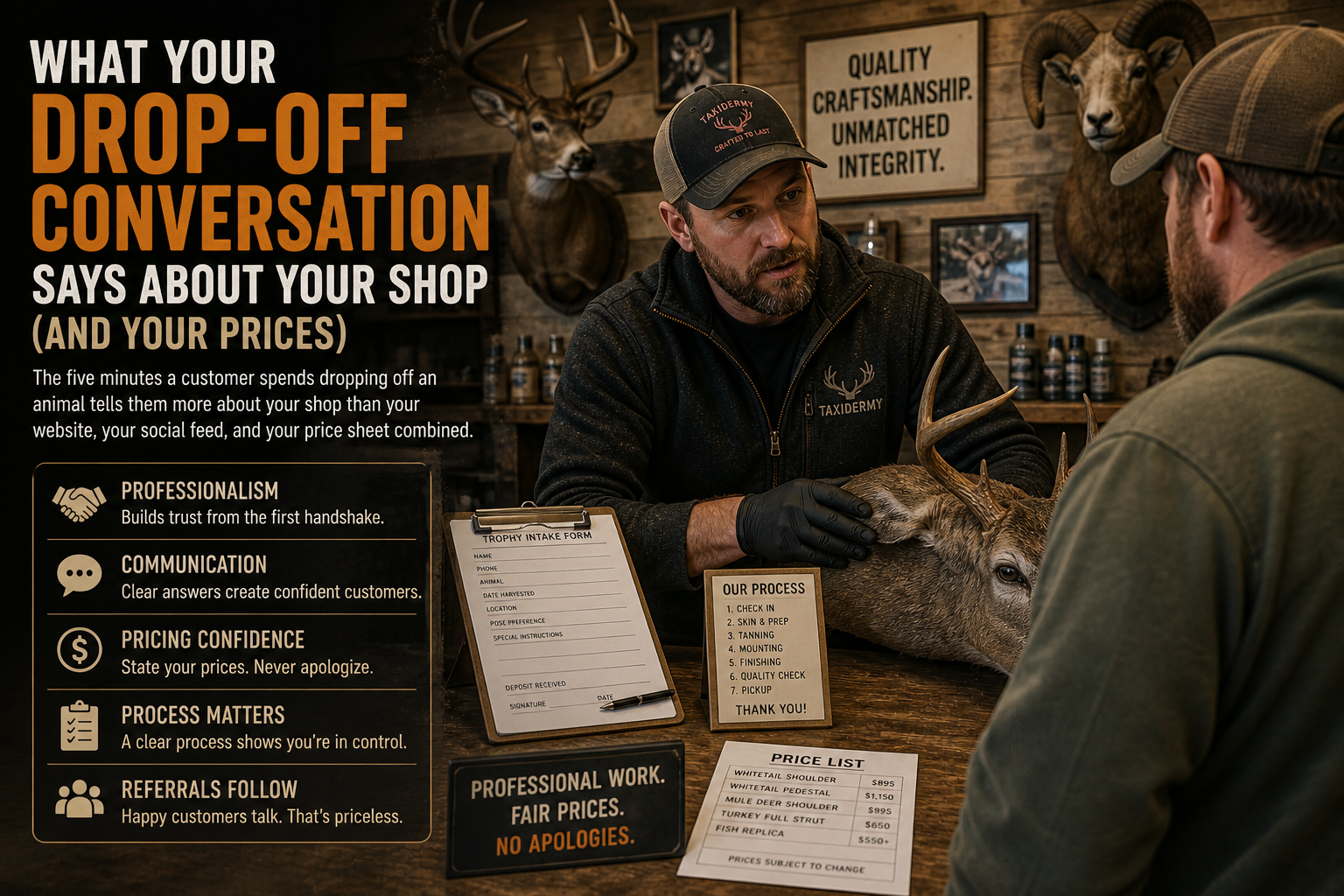
The five minutes a customer spends dropping off an animal tells them more about your shop than your website, your social feed, and your price sheet combined. Most taxidermists are saying the wrong things — and pricing themselves down in the process.
The Conversation You Don’t Realize You’re Having
Every drop-off is a sales conversation, whether you treat it like one or not. The customer is standing in your space, looking at your work, watching how you handle their animal, and listening to every word you say. In those few minutes, they decide three things:
- Whether you’re a professional or a hobbyist.
- Whether your prices feel reasonable, high, or suspiciously low.
- Whether they’ll send their buddies to you next season.
You don’t get to opt out of that conversation. You only get to decide whether you’re running it on purpose or letting it run you.
“Every drop-off is a sales conversation, whether you treat it like one or not.”
What Customers Are Actually Reading
Customers aren’t taxidermists. They can’t tell a great cape from a mediocre one at a glance, and they can’t judge your sculpting from across the room. So they read the things they can judge — and they read them fast.
They read your shop: clean or cluttered, organized or chaotic, smells professional or smells like neglect.
They read your hands: gloved or bare, careful or rough, fast or fumbling when you handle their trophy.
They read your paperwork: a real intake form, or a sticky note and a Sharpie.
They read your tone: confident and clear, or hesitant and apologetic.
By the time you’ve actually quoted a price, they’ve already decided whether that price is going to feel fair. The number is just confirmation of what the room already told them.
The Apology Trap
The most expensive mistake taxidermists make at drop-off is apologizing.
Apologizing for the turnaround time. Apologizing for the price. Apologizing for the deposit. Apologizing for the wait list. Apologizing for not being able to do exactly what the customer asked for in exactly the way they asked for it.
Every apology is a discount the customer didn’t ask for. It tells them the price isn’t quite right, the timeline isn’t quite right, and you know it. That’s an invitation to negotiate — and customers will take it.
You can deliver the same information without a single apology in it. “Turnaround is currently twelve to fourteen months. Deposit is half down at drop-off. Final balance is due at pickup.” That’s it. No “I know that’s a long time, sorry about that.” No “I wish I could do it faster.”
“Every apology at drop-off is a discount the customer didn’t ask for.”
What a Professional Drop-Off Sounds Like
A clean drop-off conversation has a rhythm to it, and once you’ve run it a few hundred times it should feel like muscle memory. Roughly:
- Greet, then handle the animal. Take it from them, look at it, comment specifically on something — the cape condition, the rack, the fish’s color. One specific sentence beats five generic ones.
- Ask the questions you actually need answered. Where was it shot or caught? When? How was it handled? Any damage? Any preference on pose? You’re not making small talk — you’re collecting information.
- Tell them what happens next, in order. “We’ll skin it out and get it to the tannery this week. You’ll get a call when we start mounting. Pickup will be roughly twelve months from today.” Customers calm down the moment they know the sequence.
- State the price and the deposit, plainly. Once. Don’t repeat it, don’t soften it, don’t explain it unless they ask.
- Get a signature on a real intake form. Pose, finish details, contact info, deposit collected. This isn’t bureaucracy — it’s the document that protects both of you.
- Close with a simple thank-you and a timeline. “Thanks for bringing it to us. We’ll be in touch around [month].”
That whole conversation can run in five to seven minutes. Done well, it does more for your reputation than any Facebook post you’ll ever make.
The Price Conversation Inside the Drop-Off
Most taxidermists hate quoting price out loud. So they mumble it, hedge it, or push it off to “we’ll figure it out at pickup.” Every one of those moves costs you money.
State the price clearly, the way a doctor’s office states a copay. It’s a number. You’re not asking permission. If your price sheet says a shoulder mount is $895, the words out of your mouth are “Shoulder mount is eight ninety-five, half down today.” Then you stop talking.
The silence after a price quote feels long. Let it. The customer needs a beat to absorb it, and if you fill that silence with justifications, you’re telling them the price is negotiable. It isn’t.
If they push back, you have one professional response ready: “I understand. The price reflects the work, the materials, and the turnaround. It’s the same for everyone who walks in.” That sentence handles 95% of pushback without an argument.
“State the price the way a doctor’s office states a copay. It’s a number. You’re not asking permission.”
What Your Shop Says Before You Open Your Mouth
The drop-off conversation starts before any words are exchanged. The walk from the customer’s truck to your counter is part of it.
A few low-cost things that quietly raise your perceived value:
- A clean, lit drop-off area. Not your whole shop — just the part the customer sees. Sweep it. Light it. Put one or two finished mounts where they’ll see them.
- A real counter or table to work on. Not the floor, not the tailgate.
- A printed price sheet they can take with them. This signals that your prices are set, not invented in the moment.
- A clipboard with intake forms. Pen attached. It’s a tiny thing, and it says “we’ve done this before.”
- A receipt — paper or emailed. Customers who get a receipt almost never argue about the deposit later.
None of this is expensive. All of it changes how the customer reads your prices on the way out the door.
The Customers You Want to Filter Out at Drop-Off
A good drop-off conversation also tells you something about them. Pay attention.
The customer who tries to negotiate price at the counter will try to negotiate again at pickup. The one who shows up with a poorly handled animal and shrugs about it will be unhappy with the result no matter what you do. The one who won’t put a deposit down today is telling you they don’t actually intend to pay later either.
You don’t have to take every animal that walks in the door. A polite “I don’t think we’re the right shop for this one” said at drop-off is a thousand times cheaper than dealing with the same customer twelve months from now at pickup. Trust what the conversation is telling you.
The Pickup Bookend
The drop-off sets the expectation. The pickup either delivers on it or breaks it. If you ran a clean, confident drop-off and then hand the customer a finished mount on a dirty piece of cardboard with no paperwork, you’ve undone everything.
Mirror the drop-off at pickup. Clean handover. Specific comments about the finished piece. A printed final invoice. A thank-you. A business card or two for them to pass along. The customer leaves your shop the same way they came in — feeling like they’re dealing with a professional.
That’s the customer who tells three hunting buddies about you over the winter. That’s the referral pipeline that runs without a single ad dollar.
The Professional Drop-Off: A One-Page Script & Intake Checklist
A printable companion to this article — free to use in your shop.
The 6-Step Drop-Off Script
Run every drop-off in this order. Five to seven minutes, every time.
1. Greet & take the animal. Hands ready. Take it from them. Look at it.
“Let’s get a look at him. Nice cape on this one — clean ears, no rub spots.”
2. Ask the five questions. Where was it taken? When? How was it handled or stored? Any damage you noticed? Pose preference, or do you want a recommendation?
3. State the sequence. Tell them exactly what happens next, in order.
“We’ll skin it out this week and get it to the tannery. You’ll get a call when we start mounting. Pickup will be roughly [X] months from today.”
4. State the price — then stop talking. One sentence. No softening. No apologizing.
“Shoulder mount is [$XXX], half down today, balance at pickup.”
Let the silence sit.
5. Intake form & deposit. Clipboard, pen, signature, deposit collected, receipt given.
6. Close with a timeline.
“Thanks for bringing him to us. We’ll be in touch around [month].”
Things to Never Say at Drop-Off
- “Sorry it’s such a long wait…”
- “I know that’s a lot, but…”
- “We can probably figure something out…”
- “Just pay me whenever…”
- “I’ll get to it when I can…”
Every one of these is a discount the customer didn’t ask for.
The One-Line Pushback Response
When a customer pushes on price, use this. Once. Calmly.
“I understand. The price reflects the work, the materials, and the turnaround. It’s the same for everyone who walks in.”
Then stop talking.
Intake Form Checklist
Before the customer leaves the counter, every box should be checked:
- Customer name, phone, email, address
- Species & sex
- Date and location taken
- Tag number (if applicable)
- Condition notes (damage, hair slip, rub, etc.)
- Pose / mount style selected
- Eye, habitat, or base preferences noted
- Quoted price written on the form
- Deposit collected and amount written down
- Estimated pickup window
- Customer signature
- Receipt issued
- Tag attached to the animal — not the form
The Drop-Off Area — Quick Audit
Walk the customer’s path before opening day. Check:
- Floor swept, lights on, no clutter on the counter
- One or two finished mounts visible
- Printed price sheet within reach
- Clipboard, pen, intake forms ready
- Trash can not visible from the counter
- Hands clean and gloves available
Red Flags — When to Politely Decline
If the customer:
- Refuses to leave a deposit
- Pushes hard on price at the counter
- Brings in an animal that was badly handled and shrugs about it
- Demands a turnaround you can’t honor
- Has a history of late pickups or unpaid balances
A polite “I don’t think we’re the right shop for this one” at drop-off saves a year of headaches at pickup.
The Pickup Bookend
Whatever standard you set at drop-off, match it at pickup:
- Mount clean, dust-free, and presented well
- Specific comment on the finished piece
- Printed final invoice
- Balance collected before the mount leaves the shop
- Thank-you and two business cards for referrals
The Bottom Line
Your drop-off conversation is the cheapest, highest-leverage marketing tool in your shop. It costs nothing, it happens dozens of times a season, and it sets the price every customer is willing to pay before they ever see your invoice.
Run it like an amateur and you’ll be apologizing your way to a discount every time.
“Run your drop-off like an amateur and you’ll apologize your way to a discount, every single time.”
Run it like a professional and you’ll find that your prices stop being a problem — because by the time the customer hears the number, they’ve already decided you’re worth it.