

Why Every Taxidermist Should Be Doing Time Studies (And How to Start)
Most taxidermists know roughly how long things take.
- “A duck takes me about an hour to skin.”
- “Mounting a deer head is a half-day job.”
- “Caping takes a bit, depends on the animal.”
But “roughly” isn’t good enough if you’re trying to:
- Price your work correctly
- Improve your workflow
- Make more money without working more hours
That’s where time studies come in.
What Is a Time Study?
A time study is simply tracking how long a task actually takes from start to finish.
Not just the main task — but everything around it:
- Setup
- Finding tools
- Cleaning up
- Interruptions
- Switching between jobs
It’s about measuring reality, not guessing.
You don’t need anything fancy to start. A stopwatch, your phone timer, or even a notebook works just fine.
Why Time Studies Matter
Most shops are losing time in ways they don’t even realize.
You might think:
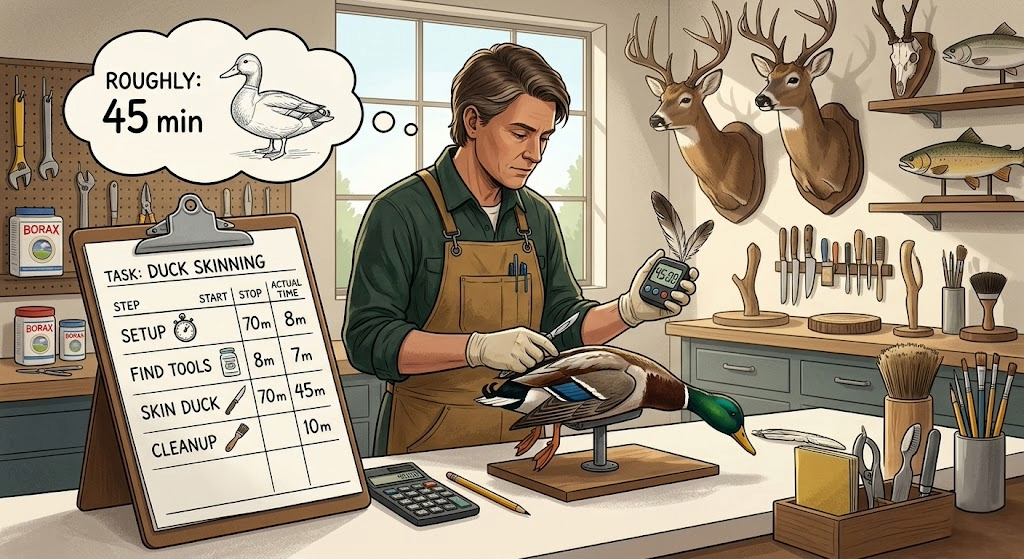
“It takes me 45 minutes to skin a duck.”
But when you actually track it, you might find:
- 10 minutes finding tools
- 5 minutes setting up your table
- 45 minutes skinning
- 10 minutes cleanup
Now that “45-minute job” is really a 70-minute process.
That difference matters.
Here’s why:
1. Accurate Pricing
If you don’t know how long something takes, you’re guessing your prices.
And guessing usually means:
- Undercharging
- Working longer hours
- Lower profit
2. Identifying Wasted Time
Time studies expose things like:
- Walking back and forth for tools
- Searching for supplies
- Repeating setup steps
- Poor shop layout
These are silent profit killers.
3. Better Workflow
Once you see where time is going, you can:
- Streamline processes
- Organize your workspace
- Reduce unnecessary movement
4. Foundation for Future Improvements
This becomes especially important when you start thinking about:
- Shop organization
- Hiring help
- Scaling your business
(We’ll dig deeper into organization in a future article.)
Example: Skinning a Duck
Let’s break this down the right way.
Most people would say:
“Skinning a duck takes about 45 minutes.”
But a proper time study looks like this:
Step-by-step breakdown:
- Pull bird from freezer / thawed storage
- Gather tools (scalpel, scissors, borax, etc.)
- Set up workspace
- Skin the duck
- Clean up tools and area
What you might discover:
- 8 minutes gathering tools
- 7 minutes setting up
- 45 minutes skinning
- 10 minutes cleanup
Total: 70 minutes
That means:
- Only 64% of your time was actual skinning
- The rest was support work
That’s eye-opening.
The Hidden Problem: Setup Time
One of the biggest things time studies reveal is setup inefficiency.
Questions to ask:
- Are your tools always in the same place?
- Do you have to stop mid-process to grab something?
- Are you walking across the shop multiple times?
- Are you resetting your workspace every single time?
If you’re spending:
- 10–15 minutes just getting ready for each task
That adds up fast over a week, month, or season.
How to Do a Time Study (Simple Method)
You don’t need spreadsheets or software to start.
Step 1: Pick a Task
Start with something common:
- Skinning a duck
- Caping a deer
- Mounting a fish
Step 2: Use a Timer
Use:
- Your phone
- A stopwatch
- A simple timer app
Step 3: Track Everything
Start the timer before you begin setup.
Don’t just time the “main work.”
Track:
- Setup
- Actual work
- Cleanup
Step 4: Write It Down
Keep it simple:
- Notebook
- Whiteboard
- Notes app
Example:
- Duck #1 – 68 minutes
- Duck #2 – 72 minutes
- Duck #3 – 65 minutes
Step 5: Repeat
Do it multiple times.
You’re looking for patterns, not one perfect number.
What You Should Be Tracking
Eventually, you want to track all parts of your production:
- Skinning
- Caping
- Mounting
- Finishing work
- Painting
- Drying prep
- Shop cleanup
- Tool prep
Even things like:
- Answering customer calls
- Receiving animals
- Tagging and labeling
All of it is time.
What Most Taxidermists Will Realize
After doing time studies, most people discover:
- They’re underestimating total job time
- Setup and cleanup take longer than expected
- They lose time searching for tools
- Their workflow isn’t as efficient as they thought
And that’s a good thing.
Because now you can fix it.
Final Thoughts
If you’re not tracking your time, you’re guessing.
And guessing leads to:
- Underpricing
- Burnout
- Slower growth
A simple timer can completely change how you understand your business.
Start small:
- Pick one task
- Track it honestly
- Do it a few times
You’ll learn more in a week of time studies than you have in years of estimating.
Coming Next
In a future article, we’ll build on this and talk about:
How shop organization directly impacts your time—and how to fix the biggest time-wasters.
Because once you know where your time is going…
You can start taking it back.









 A time study guide for Taxidermists)