
When Criticism Cuts Deeper Than Skin
As taxidermists, we don’t simply build mounts. We create memories.
Every deer, elk, bear, turkey, or fish that enters our shop represents a moment in someone’s life. A hunt they dreamed about for years. Time spent with family. A memory they want preserved forever. We understand that responsibility, and because of that, we pour our hearts into every piece.
Most people never see what goes into a mount before it leaves the shop.
They don’t see the hours spent sculpting details. They don’t see the late nights fixing something that nobody else would notice. They don’t see the years of learning, failing, improving, and striving to become better artists.
What they see is the finished mount.
Sometimes that mount is met with excitement, gratitude, and appreciation. Those are the moments that remind us why we do what we do.
But sometimes, despite our best efforts, a customer finds fault.
That’s part of business. Constructive criticism is valuable. Nobody is perfect, and every taxidermist can continue learning.
What hurts is when the criticism isn’t constructive. When a customer tears apart months of work over something insignificant, misunderstood, or completely unfounded.
In those moments, it can feel like all the hours, all the dedication, and all the passion mean nothing.
The truth is, artists often carry criticism much longer than compliments. One negative interaction can outweigh dozens of satisfied customers if we allow it to.
I’ve learned that when criticism stings the most, it’s usually because we cared the most.
If I didn’t care about the quality of my work, a complaint wouldn’t bother me. If I wasn’t emotionally invested, I could simply shrug it off. But taxidermy isn’t just a job. For many of us, it’s part of who we are.
There are days when criticism makes you question everything.
Was the work good enough?
Am I cut out for this?
Should I even continue?
Those thoughts are normal. Every craftsman who has spent years pursuing excellence has likely faced them.
What matters is remembering the bigger picture.
One person’s opinion does not erase years of dedication.
One complaint does not define your ability.
One difficult customer does not speak for the hundreds of people who proudly display your work in their homes.
The mounts hanging on walls across the country tell the real story. They represent the countless customers who trusted you, appreciated your craftsmanship, and valued the effort you put into preserving their memories.
Recently, I experienced one of those moments firsthand.
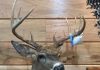
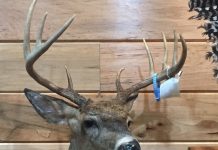
I had completed a mount that I was genuinely proud of. The eyes were right. The ear butts were sculpted exactly the way I wanted them. The muscle detail was clean and natural. The hide wrap on the pedestal came together beautifully. It was one of those pieces where I stepped back and thought, They’re going to love this.
Instead, I received a phone call questioning whether it was even their cape.
Not only that, but they believed that the cape was from a completely different species than the animal they had harvested. To make matters worse, they had a third party reinforcing those concerns.
The reality was much simpler. The cape had been harvested in wet conditions and was covered with mud when the animal was brought in. Anyone who has spent time around wildlife knows that moisture, mud, lighting, and hair position can dramatically change an animal’s appearance. A wet, muddy hide laying on the ground can look very different from the same hide months later after it has been professionally tanned, groomed, mounted, and displayed indoors.
On top of that, they were comparing a photograph of the finished mount hanging on a wall indoors to a photograph of the animal laying on the ground outside immediately after the hunt. Different lighting, different angles, different hair presentation, and a completely different perspective all contributed to the confusion.
I tried explaining these differences. I explained how lighting affects color. I explained how hair lays differently once a cape is cleaned, dried, and mounted. I explained how the same animal can appear dramatically different between a field photo and a finished taxidermy piece. But sometimes people become convinced of something and simply cannot see beyond it.
As taxidermists, we spend years learning anatomy, hair patterns, coloration, seasonal changes, and species characteristics. Sometimes we forget that many clients are seeing these details through the lens of a single photograph taken on one day under one set of conditions.
Honestly, sending pictures to customers before pickup is a whole separate topic that deserves its own article someday.
The difficult part wasn’t being questioned. The difficult part was knowing how much of myself I had invested in that piece.
I remembered every detail I had obsessed over while building it. Every decision. Every hour. Every correction. Every attempt to make it the best mount possible.
As artists, we often imagine people noticing the details we worked so hard to perfect. We imagine them admiring the expression, the anatomy, the craftsmanship, and the realism.
Instead, sometimes the first thing they see is a problem that doesn’t actually exist.
That experience reminded me of something important.
I cannot create art solely for the approval of others.
If I tie my satisfaction to every customer’s opinion, then my happiness will always be in someone else’s hands. The reality is that some people will love your work, some people will never be satisfied, and some will convince themselves of things that simply are not true.
What I can control is the effort I put into every piece.
I can control my standards.
I can control the pride I take in my work.
At the end of the day, I have to create the best mount I am capable of creating—not for validation, not for praise, but because that’s who I am as an artist.
The mount hanging on the wall still represents the same craftsmanship, the same attention to detail, and the same passion that went into it before the criticism ever arrived.
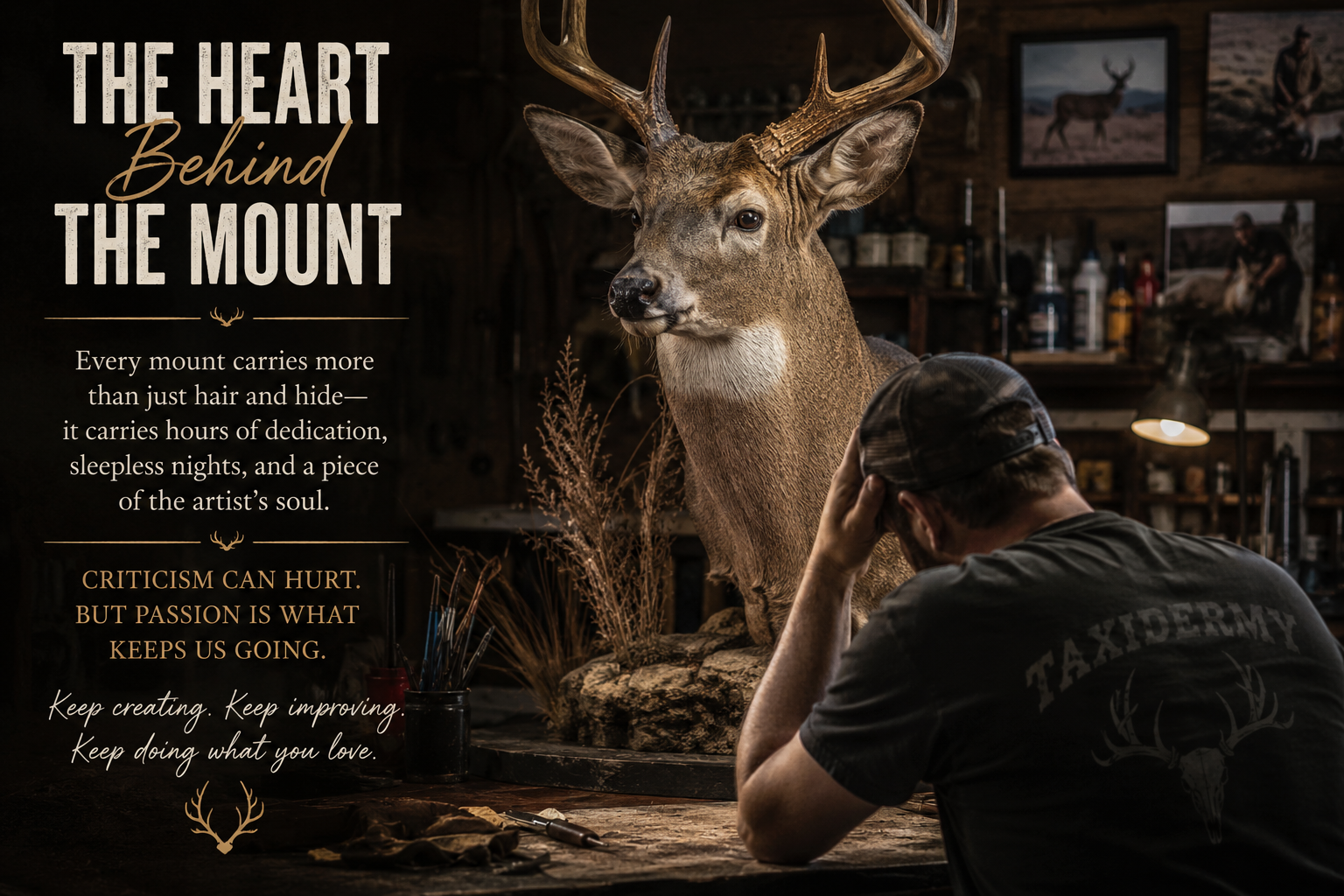
Taxidermy requires thick skin, but it also requires heart.
Without heart, the work becomes just another job.
With heart, the criticism hurts—but the rewards mean more too.
To every taxidermist who’s been discouraged by unfair criticism, remember this:
Keep improving.
Keep learning.
Keep creating.
And don’t let one negative voice silence the passion that brought you into this profession in the first place.
The animals will keep coming through the door. New memories will be made. New mounts will leave the shop.
And the work you create will continue speaking louder than the criticism ever could.