
The Truth About Negative Reviews in Taxidermy — And Why They Might Help Your Business
In taxidermy, reputation isn’t just important—it’s everything.
You’re not selling a product someone can return in a week.
You’re preserving a memory. A moment. Sometimes a once-in-a-lifetime animal.
So when a negative review shows up, it hits different.
It feels personal.
“You can do everything right—and one bad review still sticks with you.”
But here’s the reality most people don’t want to admit:
Negative reviews aren’t always a bad thing.
Handled the right way, they can actually make your business stronger.
You’re Not Going to Please Everyone
Let’s start with reality.
No matter how skilled you are, how much you care, or how hard you work…
You will not make everyone happy.
In taxidermy, expectations vary more than most people realize:
-
One client wants absolute realism
-
Another wants a “bigger than life” look
-
Some expect fast turnaround
-
Others don’t understand the process at all
And sometimes?
You just get a difficult customer.
“Perfection in taxidermy isn’t objective—it’s personal.”
Real-World Example
A customer brings in a mature whitetail. You mount it clean, accurate, and anatomically correct.
They come to pick it up and say:
“It doesn’t look as big as it did when I shot it.”
Now you’re dealing with perception vs. reality.
The mount might be excellent—but it didn’t match the story in their head.
“In taxidermy, you’re not just mounting animals—you’re managing expectations.”
Why a Perfect Rating Can Actually Hurt You
It sounds backward—but a shop with only 5-star reviews can raise red flags.
Today’s customers are skeptical.
They’re asking:
-
Are these real?
-
Is anything being filtered out?
-
Is this too good to be true?
A mix of reviews—good and bad—actually builds trust.
“People don’t trust perfection. They trust how you handle imperfection.”
Real-World Example
A customer compares two shops:
-
Shop A: 5.0 stars, 40 reviews
-
Shop B: 4.6 stars, 120 reviews—with a few negatives, but strong responses
Many will choose Shop B.
Because it feels honest.
What Customers Are Really Looking At
Most potential clients don’t fixate on the bad review itself.
They look at your response.
That’s where decisions are made.
A professional reply shows:
-
You care
-
You’re accountable
-
You stand behind your work
A defensive response does the opposite.
And it can cost you more than the review ever would.
“Your response is your reputation—on display.”
Real-World Example
A review says:
“Took way longer than promised.”
Bad response:
“That’s not true. You were told the timeline.”
Good response:
“We understand the frustration with timing. Turnaround can vary depending on workload and tanning schedules, but we always aim to communicate clearly. We appreciate your patience and feedback.”
Same situation. Completely different outcome.
The Trap of Taking It Personally
This is where most taxidermists struggle.
Because this work is personal.
You care about the details. The craft. The outcome.
So when someone criticizes it—it feels like they’re criticizing you.
Real-World Example
A customer leaves a review:
“The mount just looks off.”
No explanation. No specifics.
Your instinct?
Defend the work.
But here’s the reality:
Future customers aren’t judging the mount…
They’re judging how you handle criticism.
“You don’t win by proving them wrong—you win by staying professional.”
Negative Reviews Can Filter Out the Wrong Customers
This is one of the most overlooked benefits.
Not every customer is a good fit.
Real-World Example
A review says:
“Too expensive for what you get.”
Another customer reads that and thinks:
“Good—that means they’re not the cheapest shop.”
Or:
“Took 10 months to get my deer back.”
Someone looking for a 3-month turnaround might walk away.
And that’s okay.
“The wrong customers walking away is not a loss—it’s protection.”
Sometimes the Review Is Right
This is the hard part.
Not every negative review is unfair.
Sometimes, it points to real issues.
Real-World Example
You start noticing a pattern:
-
“Hard to get ahold of”
-
“Didn’t get updates”
-
“Didn’t return calls”
That’s not random—that’s a signal.
Fixing communication alone can:
-
Reduce complaints
-
Improve customer experience
-
Increase referrals
“The best shops don’t ignore criticism—they refine from it.”
A Bad Review That Actually Helps You
This is where it all comes together.
Real-World Scenario
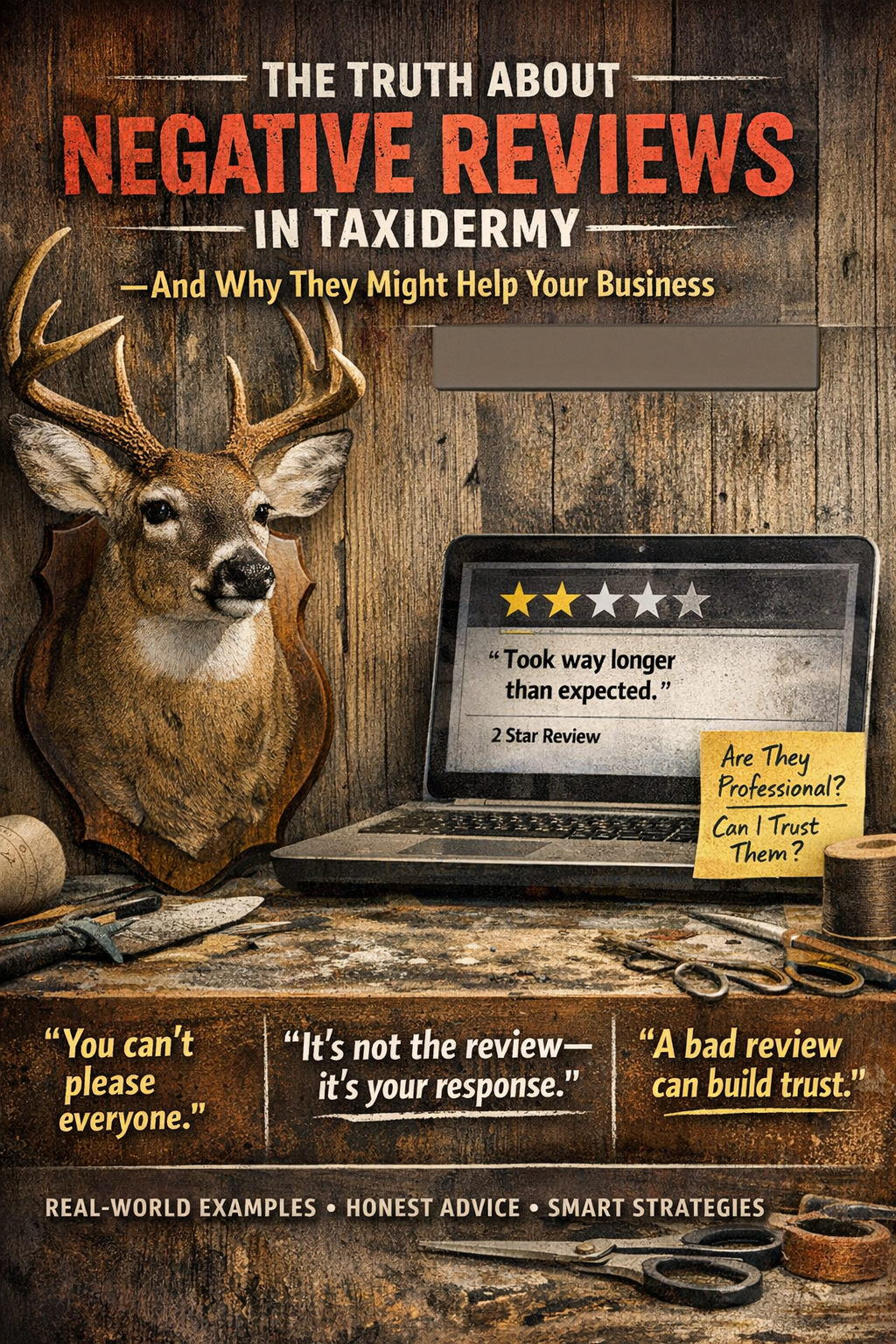
A customer leaves a 2-star review:
“Work was good, but took longer than expected.”
You respond professionally. No excuses. No defensiveness.
A future customer reads that and thinks:
-
“The work is solid”
-
“They’re honest”
-
“They communicate well”
And they still choose you.
“A well-handled bad review builds more trust than a perfect one ever could.”
The Bigger Picture
One bad review won’t hurt your business.
But how you handle it?
That absolutely can define it.
In a trade built on trust, craftsmanship, and reputation…
People aren’t just asking:
-
“Are they good?”
They’re asking:
-
“Can I trust them with my animal?”
And sometimes, the answer comes from how you handle things when they don’t go perfectly.
Final Word
Negative reviews aren’t a sign that something is wrong.
They’re a sign that you’re doing business.
“The goal isn’t to avoid negative reviews—it’s to respond in a way that builds more trust than the review ever took away.”
Because at the end of the day:
People don’t remember that you had a bad review.
They remember how you handled it.