

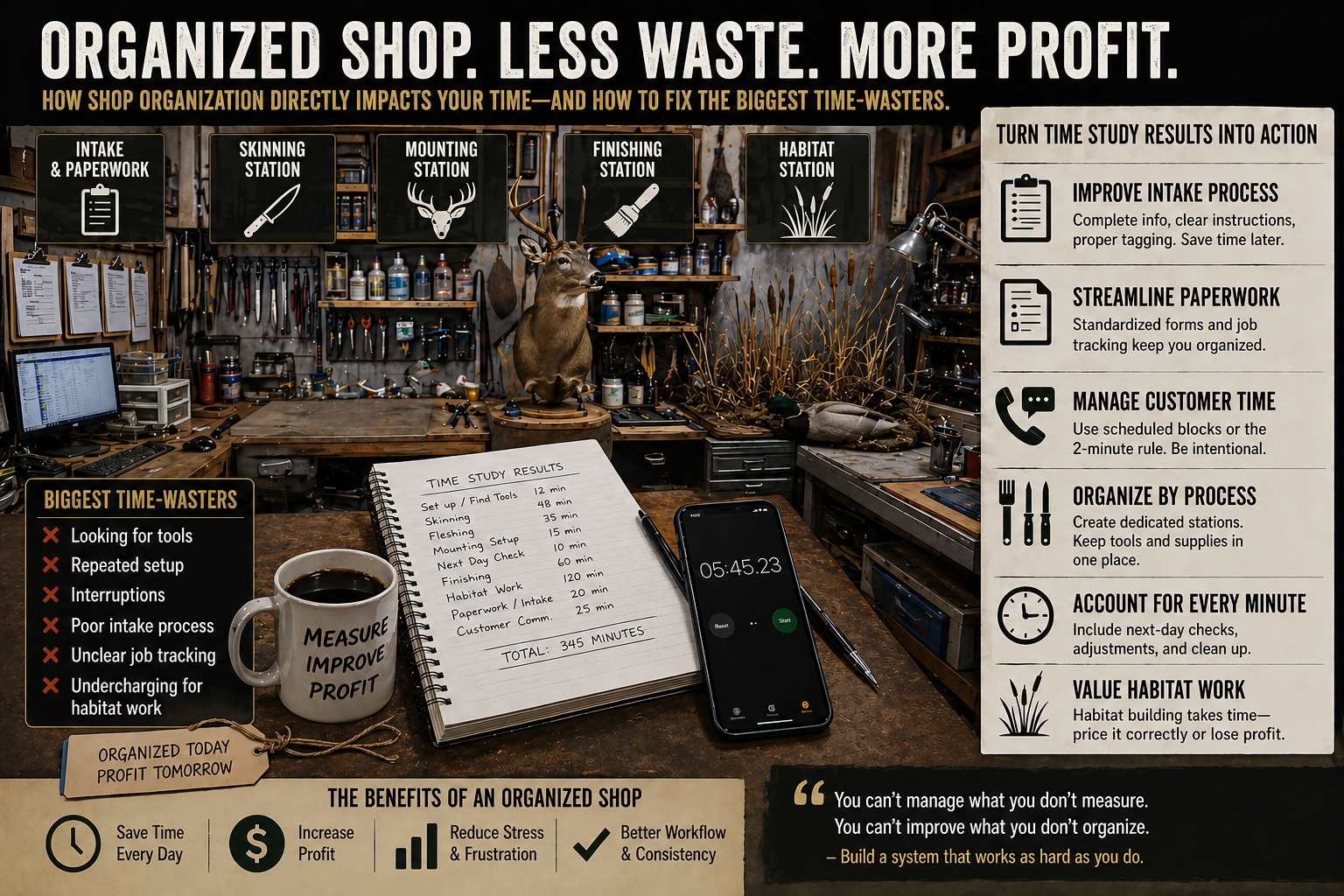
How Shop Organization Impacts Your Time (And How to Fix the Biggest Time-Wasters)
You probably realized:
- Jobs take longer than you thought
- Setup and cleanup eat up serious time
- You spend more time looking for things than you should
Now comes the important part:
What are you going to do about it?
Because a time study without changes is just interesting information.
This article is about turning those findings into:
- Faster workflow
- Less stress
- More profit
The Big Realization
After doing time studies, most shops discover this:
The problem isn’t how fast you work…
It’s how your shop is set up.
You’re not slow.
Your process is inefficient.
Where Most Time Gets Wasted
Let’s break down the biggest hidden time-wasters that show up in almost every shop:
1. Tool Hunting
- Walking across the shop
- Digging through drawers
- Borrowing tools from another station
Even 2–3 minutes per job adds up fast.
2. Repeated Setup
- Resetting your workspace every time
- Re-gathering the same supplies
- No “ready-to-go” stations
This is one of the biggest time drains uncovered in time studies.
3. Workflow Interruptions
- Phone calls
- Texts
- Customers stopping in
- Switching tasks mid-process
Each interruption resets your momentum.
4. Poor Process Flow
- Backtracking across the shop
- Moving specimens multiple times
- No clear sequence from start to finish
You’re doing extra work without realizing it.
Fixing the Problems (Based on Your Time Study)
Your time study told you exactly where you’re losing time.
Now we fix it.
1. Build “Stations,” Not Work Areas
Instead of one general workspace, think in dedicated stations:
- Skinning station
- Fleshing station
- Mounting station
- Finishing station
Each station should have:
- Its own tools
- Its own supplies
- Minimal need to leave the area
Goal:
Once you start a task, you shouldn’t have to walk away.
2. Eliminate Setup Time
Setup should not be something you “do.”
It should already be done.
How:
- Keep tools in the same place every time
- Pre-stock commonly used materials
- Use trays or kits for repeat jobs (like waterfowl)
Example:
Instead of gathering tools to skin a duck…
Have a “duck kit” ready:
- Scalpel
- Borax
- Sray Bottle
- Scissors
- Tags
Now your 10-minute setup becomes 1 minute.
3. Fix Your Intake Process
Time studies often reveal wasted time before you even start the work.
Common problems:
- Missing tags
- Incomplete paperwork
- Unclear instructions
- Time spent figuring out what the customer wanted
Fix it:
Create a standard intake system:
- Required forms filled out completely
- Clear species, pose, and options selected
- Proper tagging system
- Photos taken at drop-off
Why it matters:
Every minute you spend “figuring it out later” costs you.
4. Improve Paperwork & Workflow Tracking
Paperwork inefficiency is a silent time killer.
Look for:
- Rewriting the same information multiple times
- Searching for customer records
- Confusion about job status
Solutions:
- Standardized forms
- Job numbering system
- Simple tracking board (whiteboard or digital)
Goal:
You should be able to answer:
“Where is this job at?”
In seconds—not minutes.
5. Manage Customer Communication Time
This is a big one.
Two approaches:
Option A: Scheduled Communication Time
Set aside time daily for:
- Calls
- Texts
- Emails
Pros:
- Keeps workflow uninterrupted
- More focused responses
Cons:
- Slower replies
Option B: The “2-Minute Rule”
If it takes less than 2 minutes—handle it immediately.
Pros:
- Keeps things from piling up
- Faster customer service
Cons:
- Can interrupt deep work
Best approach?
Most shops benefit from a hybrid:
- Quick replies during the day
- Dedicated time for longer conversations
6. Organize by Process Stage
Think about your workflow like a pipeline:
- Intake
- Skinning
- Fleshing
- Mounting
- Drying / next-day checks
- Finishing
- Habitat work
- Pickup
Each stage should be:
- Clearly defined
- Physically organized in your shop
7. Don’t Forget “Next-Day” Time
Time studies often miss this:
Follow-up work.
Example:
- Checking mounts the next day
- Adjustments
- Re-wetting areas
- Minor fixes
That time matters—and it adds up.
If you’re not accounting for it:
You’re underestimating your true labor.
8. Habitat Work: The Hidden Profit Killer
A lot of taxidermists undercharge here.
Why?
Because they don’t track the time.
Reality:
- Building habitat
- Painting bases
- Arranging scenes
This can take hours.
If you’re not charging for it:
You’re losing money.
Your time study should include:
- Habitat design
- Material prep
- Assembly
9. Sales & Quoting Time
Another overlooked area.
How long do you spend:
- Talking to customers
- Explaining options
- Pricing jobs
That’s labor.
If it’s taking:
- 15–30 minutes per customer
That needs to be accounted for in your pricing.
10. Set Rules for Yourself
Organization only works if you stick to it.
Examples:
- Tools go back in the same place every time
- Stations stay stocked
- Jobs move forward—not backward
- No starting new work before finishing current stages
Consistency is what makes systems work.
The Big Shift
After applying time study results, your goal is this:
Less movement
Less searching
Less setup
More doing
Final Thoughts
Time studies show you the problem.
Organization fixes it.
If you take what you learned and apply it:
- You’ll move faster
- You’ll feel less stressed
- You’ll make more per hour
And that’s the goal.
Coming Next
In the next article, we’ll dig into:
How to turn your time data into a pricing system that actually makes you money.
Because once you know your time…
You can finally price your work with confidence.












 Taxidermy shop Setup tips)