
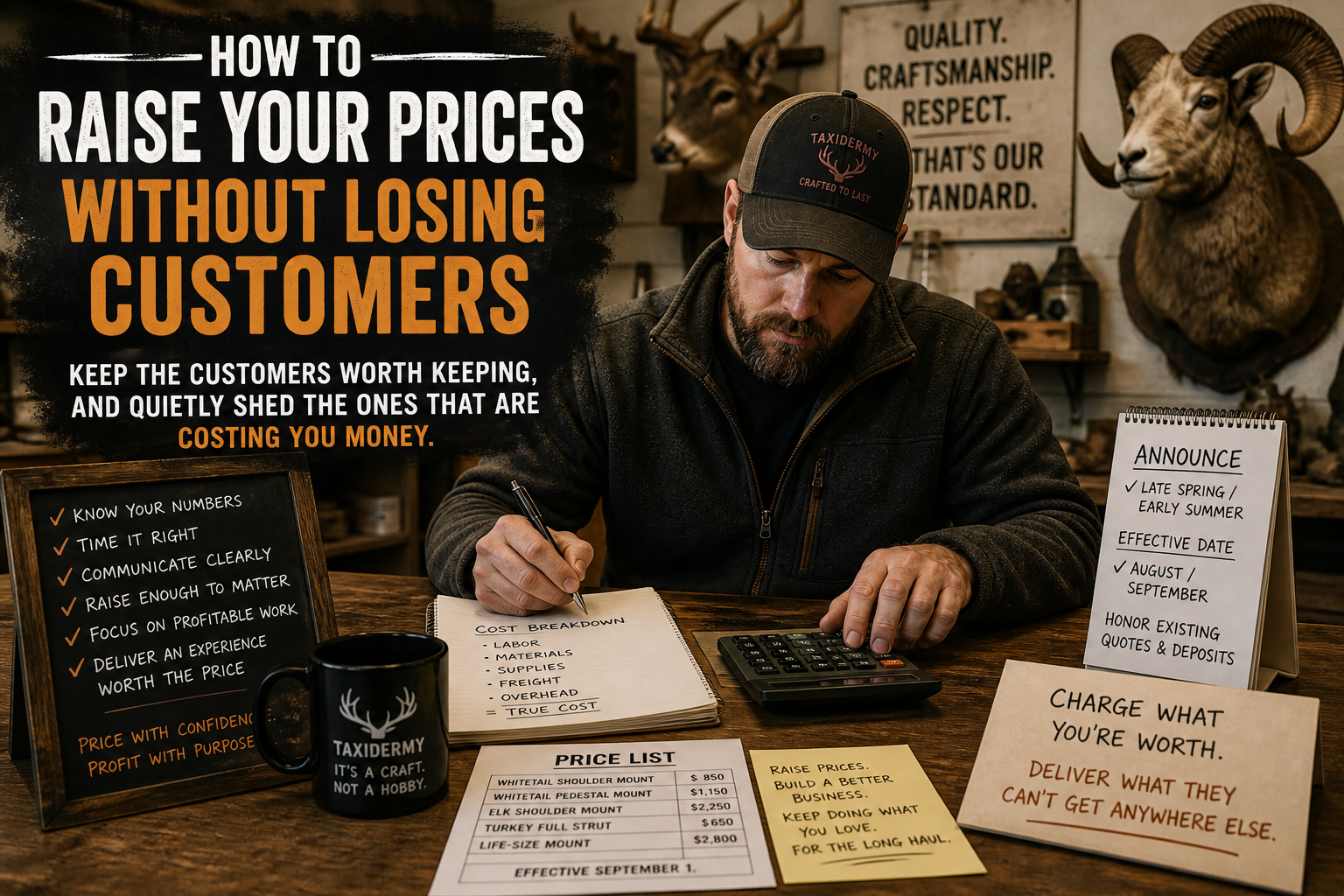
How to Raise Your Prices Without Losing Customers
Most taxidermists wait too long, raise too little, and apologize the whole way through. Here’s how to do it the right way — keep the customers worth keeping, and quietly shed the ones that have been costing you money.
Why This Conversation Is Overdue
If you haven’t raised your prices in the last 18 months, you’ve already given yourself a pay cut. Hide costs are up. Forms are up. Eye prices, freight, shop supplies, electricity, insurance — all up. And your time, the one thing you can never make more of, is the most valuable input on the list.
Yet most taxidermists treat a price increase like bad news they have to break to a partner. They mumble through it, soften it, or skip it entirely and just absorb the squeeze. The truth is: customers expect prices to go up. What they react to isn’t the increase — it’s how you handle it.
“If you haven’t raised your prices in the last 18 months, you’ve already given yourself a pay cut.”
The Real Reason Taxidermists Lose Customers Over Price
Customers rarely leave because a mount went from $650 to $725. They leave because:
- They were surprised by the change.
- They felt the increase was arbitrary or sneaky.
- The quality, communication, or turnaround didn’t match the new number.
- They were never your ideal customer to begin with.
Notice that only one of those four things is actually about money. The rest are about trust and fit. Fix those, and a price hike becomes a non-event.
Step One: Know What You’re Actually Charging For
Before you change a single number on your price sheet, sit down and figure out what each piece of work costs you in materials, supplies, freight, and — most importantly — labor hours. If you’ve already been running time studies (and you should be), this part is easy. If not, start there.
You can’t confidently raise prices when you don’t know your floor. Once you do, the conversation with yourself changes from “How much can I get away with?” to “How much do I need to be charging to actually run a business?”
Step Two: Time the Increase With the Season
The single biggest mistake taxidermists make is raising prices in the middle of fall, right when the trucks start rolling in. That’s the worst possible moment. Customers are dropping off animals they killed expecting last year’s prices, and you look like you’re price-gouging the rush.
“Announcing a price hike in the middle of fall is like raising rent on moving day.”
A better rhythm:
- Announce in late spring or early summer. The shop is quieter, drop-offs have slowed, and customers have time to absorb the news.
- Effective date in August or September, before the bulk of the season hits.
- Honor existing quotes and deposits at the old rate. Anyone already in your system gets grandfathered. New drop-offs pay the new price. This single rule kills 90% of the friction.
This timing also gives you a clean line to draw: “Animals dropped off after September 1 are at the new rate.” It’s specific, it’s fair, and it’s easy to defend.
Step Three: Communicate Like a Professional, Not an Apologist
Your customers are adults. Talk to them like adults.
A short, confident note works better than a long, defensive one. Something along these lines, in your own voice:
“Material and supply costs have continued to climb, and to keep delivering the quality of work you expect, our prices will be adjusting effective September 1. Anything already on the books at the current rate will be honored. New drop-offs after that date will reflect the updated pricing. Thank you for trusting us with your trophies — we don’t take it lightly.”
That’s it. No long-winded explanation. No graphs. No begging. Post it on your website, your social channels, and pin it inside the shop where customers drop off. Hand a printed copy out with each pickup for the month before the change.
What you should never do: raise prices silently and let people discover it on their invoice. That’s how you lose customers who would have happily paid more.
Step Four: Raise Enough to Matter
A 3% price increase isn’t a strategy — it’s a rounding error. By the time you absorb the credit card fees and the next form catalog price bump, you’re back where you started.
If you haven’t raised prices in two or three years, the increase needs to reflect that. Ten to fifteen percent is not unreasonable for most shops in this trade right now, and on certain species or services where you’re chronically underpriced, the right number may be higher. Run your costs first, then decide — but don’t talk yourself into a number so small it doesn’t change anything.
The goal isn’t to nickel-and-dime your customer base every six months. It’s to make a meaningful adjustment, hold it, and deliver such consistent quality that the new price feels obvious within a year.
Step Five: Use the Increase to Weed Out Low-Margin Work
Here’s the part most articles won’t tell you: a price increase is the cleanest, most professional way to fire the customers who have been quietly draining your shop.
“A price increase is the most professional way there is to fire the customers who have been quietly draining your shop.”
Every taxidermist has them. The customer who drops off a single squirrel and calls four times a month asking if it’s done. The guy who haggles every invoice. The one who pays late. The one whose work always takes twice as long as it should because of “just one more thing.”
When prices go up, those customers self-select out. They go shop around, find that everyone else has also raised prices (or that nobody else will tolerate them), and either come back ready to behave — or disappear quietly. Either outcome is a win.
This is also a good moment to look at the types of work that are eating your shop. If shoulder mounts are profitable but small mammals are barely breaking even, the new price sheet should reflect that gap honestly. You’re allowed to make certain work expensive enough that you only do it when you really want to.
Step Six: Earn the New Number
A price increase puts you on the hook. If you charge more, the work has to feel like more — not necessarily in flash and detail, but in the entire experience.
That means:
- Faster, clearer communication when a customer calls or texts.
- Cleaner pickup presentation. A finished mount on a clean stand with a thank-you note costs you almost nothing and lands like a hundred-dollar upgrade.
- Honest turnaround estimates, and meeting them.
- A shop and a website that look like they belong to someone charging professional rates.
If everything around the work tightens up, the new price will feel earned. If nothing changes except the invoice, customers will notice that too.
What Actually Happens When You Do This Right
The shops I’ve watched go through this the right way — clear communication, summer announcement, fall enforcement, meaningful number — almost always report the same three things:
- They lose a small handful of customers, almost all of them ones they were glad to see go.
- Their gross revenue goes up immediately, even with slightly fewer mounts on the books.
- Their stress level drops, because the math finally works.
That third one is the part nobody talks about. Running a taxidermy shop at a price that doesn’t actually cover your time is a slow grind that burns people out of the trade every year. Charging properly isn’t greedy. It’s how you keep doing this work for another twenty years.
“Charging properly isn’t greedy. It’s how you keep doing this work for another twenty years.”
The Bottom Line
Raising prices isn’t a customer-relations problem. It’s a self-respect problem dressed up like one. Know your numbers, pick the right season, tell people clearly, raise the number enough to matter, and let the customers who shouldn’t be in your shop quietly find the door.
The ones who stay are the ones you actually wanted to be working for in the first place.